A two-bottle perfume discovery set should be designed around the two finished bottles, not around a stock box size or the words “15 mL.” First decide how the bottles will sit, then design an insert that holds their bodies, leaves room to remove them, and lets the box close without touching the caps. Only after that should you approve the final box dimensions. For an initial quote, a photo or reference image plus bottle measurements, quantity, artwork status, and delivery destination is enough to start.
This guide uses two 15 mL travel sprays as an illustrative project. It also works as a planning method for other paired bottles, but the drawings below are concepts, not production dielines or tested packaging.
Decide what the customer opens first
A two-bottle set can look very different depending on the selling task. For a compact sampling kit, a simple printed carton with a fitted interior may be enough. For a gift or a set the buyer may keep, a rigid box can give the bottles a more deliberate reveal. A drawer or lid-and-base design changes the opening motion and where the insert must sit. For the general structure trade-off, see rigid boxes versus folding cartons.
For two travel sprays, make the first layout decision before choosing foil, paper texture, or the outside color:
Side by side
Both bottles face the customer at once. This works well when the fragrances should have equal emphasis and the pack can be wider. Check that there is enough space between the bottles for a finger notch or lifting method. If one bottle is wider at the cap, the insert should follow the largest complete bottle, not just the cylindrical glass body.
End to end
The bottles share one long axis, so the pack can be narrower and longer. This may fit a slim mailing or shelf presentation, but the arrangement must still make both names readable and both bottles easy to remove. Do not assume the same insert can be rotated inside a different box without resampling.
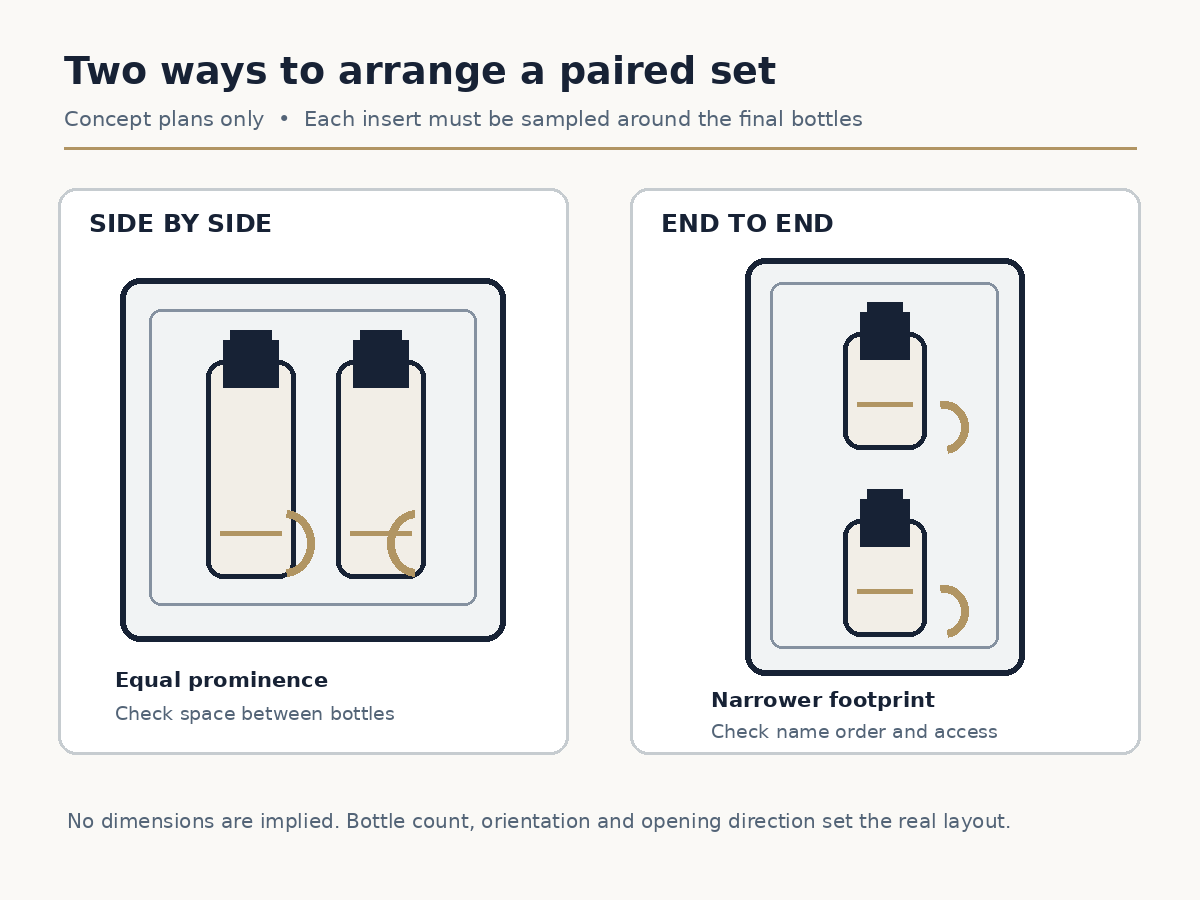
A quick decision rule: choose the layout that shows both fragrances clearly, gives each bottle independent removal access, and fits the intended unboxing. Let the bottle geometry and the physical sample decide the final footprint.
Specify the bottle before the insert
“Two 15 mL bottles” states volume and count; it does not state physical size. Photograph or measure each finished bottle with its actual sprayer, cap, collar, label, and any decorative sleeve. Record the maximum width or diameter, maximum depth, full height, and filled weight. If the two bottles differ, list both rather than using one average. The detailed measuring sequence is in LEETOP's perfume box dimensions guide.
Also mark the face that should be visible, surfaces that must not be rubbed by the insert, and whether the bottle should stand upright or lie flat. If you have not chosen the bottle yet, label those dimensions provisional. The insert cavity, outer box, and artwork must remain open to revision until a real bottle or approved engineering drawing is available.
Design for holding and removal
The insert should restrain the bottle at suitable body contact points while leaving the sprayer and cap clear. Ask for a proposed finger notch, pull tab, or accessible shoulder so the buyer can remove one bottle without pulling on the sprayer or levering against the other bottle. The physical sample must confirm fit, removal, and closure; a render cannot do that.
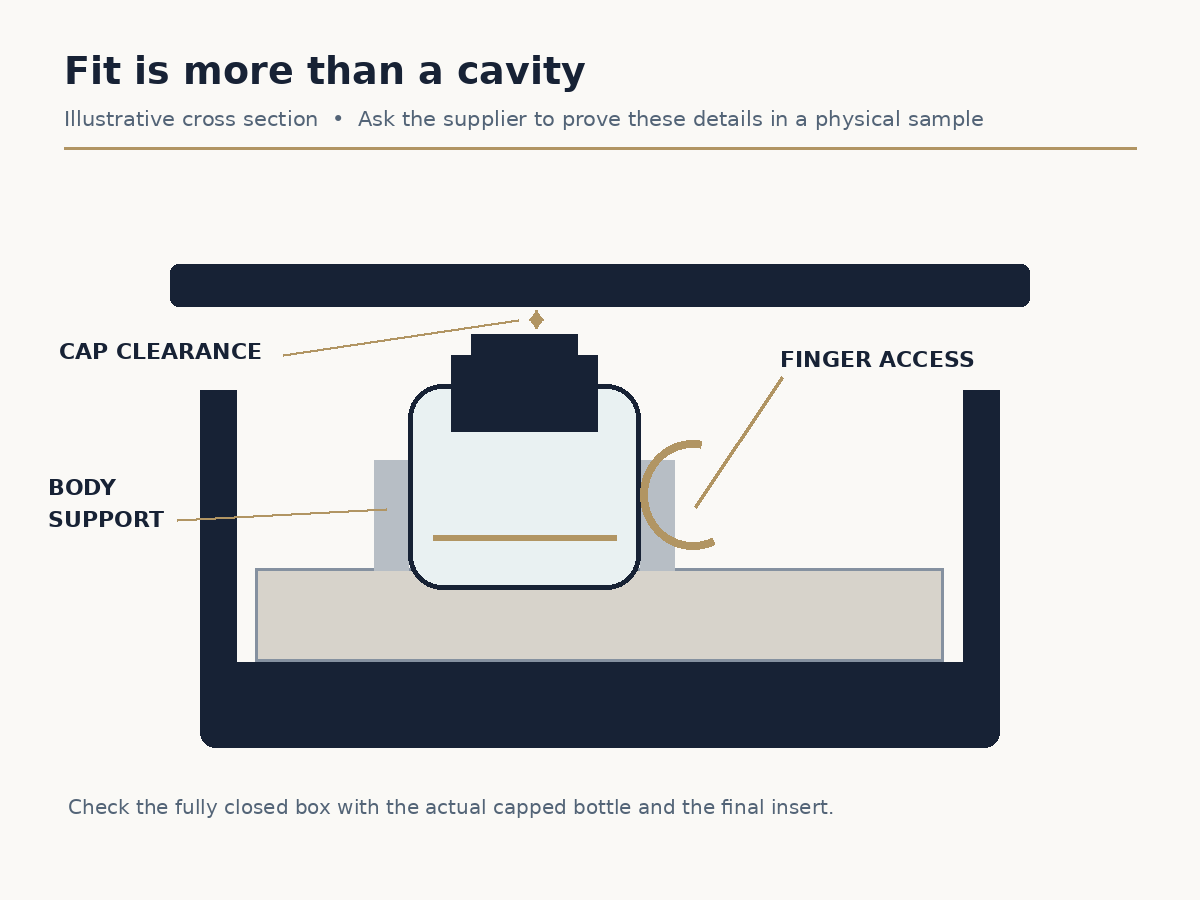
Paperboard insert: ask how its folds lock into the box, how each bottle is held, and whether a label will catch on an edge. EVA insert: ask where the body is supported and how the cutout allows a finger to lift it. Other insert routes depend on the bottle, desired appearance, quantity, and sample result. The custom insert options explain the material choices; a material name alone does not prove the finished set will fit.
Keep the retail presentation box separate from the outer shipping package in the quotation. A neat fitted insert inside the retail box does not by itself verify that filled glass bottles will survive the delivery route. If the final shipment contains filled perfume, confirm the carrier and shipper's requirements for that specific product and service separately.
Count complete sets, components, and editions
Ask for a quote in complete sets, then list the components in each set. In the illustrative two-bottle project, 100 sets require 100 outer boxes, 100 inserts, and 200 bottles if each set includes two bottles. If each scent has its own label, name which label goes on which bottle. This simple count keeps an “all-in” quote from quietly excluding the second bottle or label.
If you plan two editions with different fragrance pairs, state the quantity per edition. One shared box print may be possible while the bottle labels or information cards change, but the supplier must quote those variations explicitly. Do not assume that 100 sets split into two designs meet the same production minimum as 100 identical sets.
LEETOP's fragrance packaging page lists custom discovery packaging, fitted inserts, and coordinated bottles and labels. Selected projects start from 100 boxes; the workable minimum and final price depend on the actual box, insert, printing, and edition plan. Request separate prices at your likely first order and next realistic reorder quantity so the comparison is useful.
Send a brief that can actually be quoted
Copy these fields into your supplier message. Mark unknowns as “to be developed” instead of guessing a final box size:
- Product: two finished travel sprays per set; bottle supplier and model if known.
- Bottle A / bottle B: maximum width or diameter × depth × full height with cap, plus filled weight and front/side photos. State whether dimensions are final or provisional.
- Presentation: side by side or end to end; which faces and fragrance names should show when opened.
- Box direction: folding carton, lid-and-base rigid box, drawer box, or ask the supplier to propose a suitable option.
- Insert: preferred material if any; where the body may be held, surfaces to protect, and how the buyer removes each bottle.
- Included components: outer box, fitted insert, empty bottles, labels, printed card, or packaging only. State who fills, labels, and assembles the set.
- Artwork: logo, vector files if available, or an AI image, sketch, or reference photo to start design development.
- Order: number of complete sets per design, possible reorder quantity, destination ZIP/postal code, and target delivery date.
- Quote scope: ask for the box, insert, other components, sample/development charges, and door-to-door delivery to be identified separately before comparing offers.
For example, a useful opening message is: “We need 100 two-bottle discovery sets for two 15 mL travel sprays. We have the bottle photos and will send measured dimensions. Please propose side-by-side and end-to-end layouts, show the insert material and removal method, and quote the box, insert, optional bottles and labels, sampling, and delivery to [ZIP code] separately.” The 100 is an example inquiry quantity, not a universal minimum for every construction.
Approve the real set, then lock the artwork
Put both final bottles into a physical sample. Close the box normally. Lift each bottle out and return it several times; check whether labels scrape, caps touch the lid, bottles lean or rattle, and the insert stays in place. Check the completed set with the card and labels included, not an empty box. Record the approved bottle references, insert version, final inside and outside box dimensions, and artwork revision together. The sampling guide explains what a physical sample should resolve before production.
Have two bottles or a reference image? Send LEETOP the bottle details, set quantity, and delivery ZIP code for a packaging proposal.