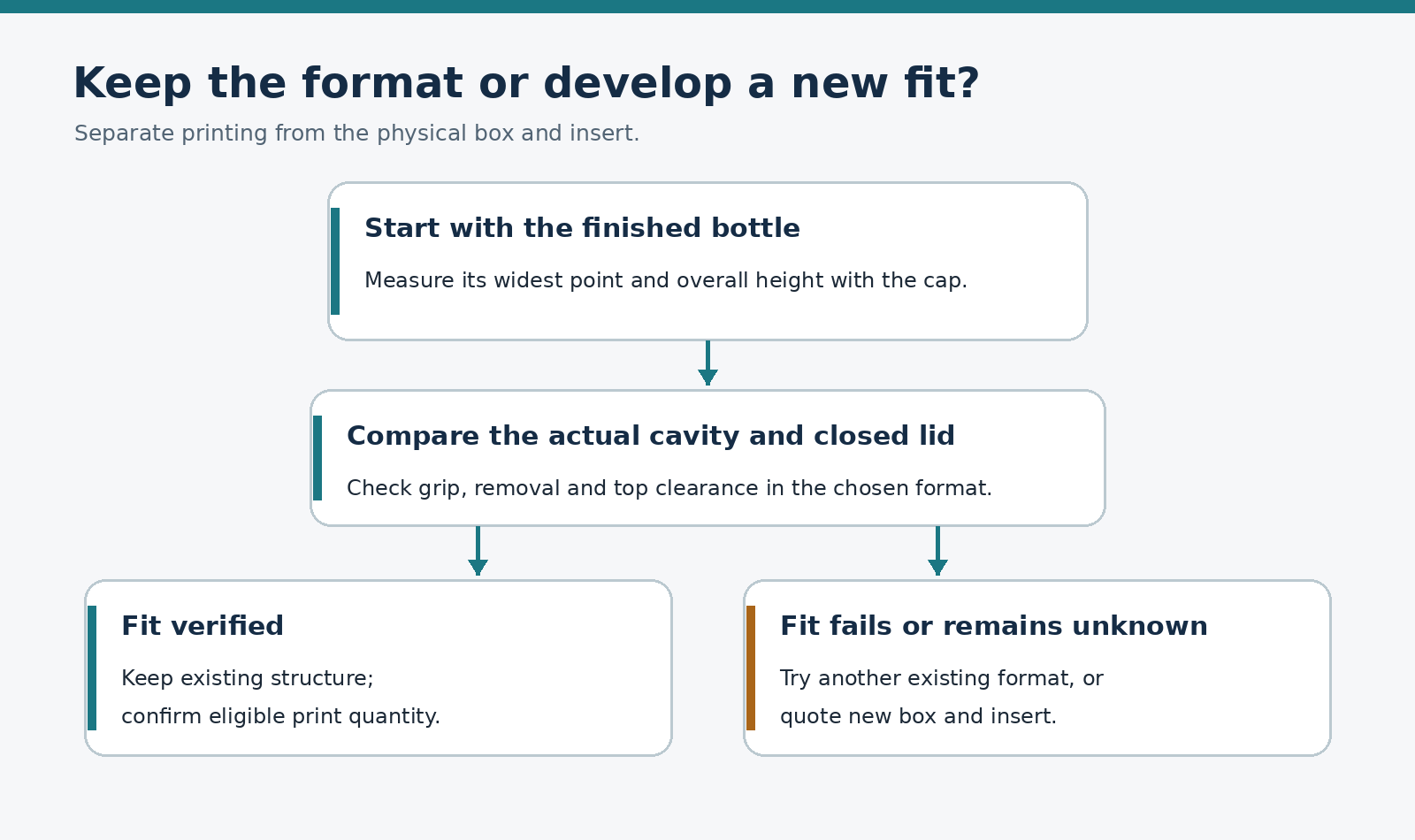
If a perfume bottle does not fit an existing box and insert, changing the print artwork will not solve the fit. First check the assembled bottle’s widest point and full height against the actual cavity and closing clearance. Keep the existing structure only when those measurements and the way the bottle is held are acceptable; otherwise ask for a different insert, a different existing format, or a newly sized box. Three anonymized fragrance inquiries show where that decision changes.
The numbers below describe those inquiries, not a universal vial standard, stock-box catalog, price list, or confirmed production result. None of the three conversations establishes a completed order or a tested final pack.
What does “custom printed” change on a fixed-size perfume box?
It can change the visible artwork while the box structure and cavity remain fixed. Ask the supplier to state separately whether the outer box size, insert cavity, number of positions, and printing can change. A printed logo does not make a too-wide vial fit or create room under the closed lid.
Inquiry 1: Five-vial sample boxes. A buyer was comparing three existing five-vial box formats for a small run. In that discussion, each fixed-size option could be printed at 100 boxes, but its size could not be adjusted. The buyer’s actual bottles would not fit the available box. A newly sized five-vial version was a separate route, with a 1,000-piece minimum for that particular configuration. The practical answer was to check the real bottle against another existing format or quote the new structure; approving only the artwork would leave the original fit problem unsolved.
Those two quantities were project-specific options, not a claim that every LEETOP custom-size box requires 1,000 pieces. LEETOP’s fragrance packaging page describes selected custom projects starting at 100 boxes; structure, insert, printing and quantity still need a project quote. This distinction is worth putting in writing before comparing a fixed format with a newly developed one.
Can a 2 mL vial fit a box discussed for 3–5 mL vials?
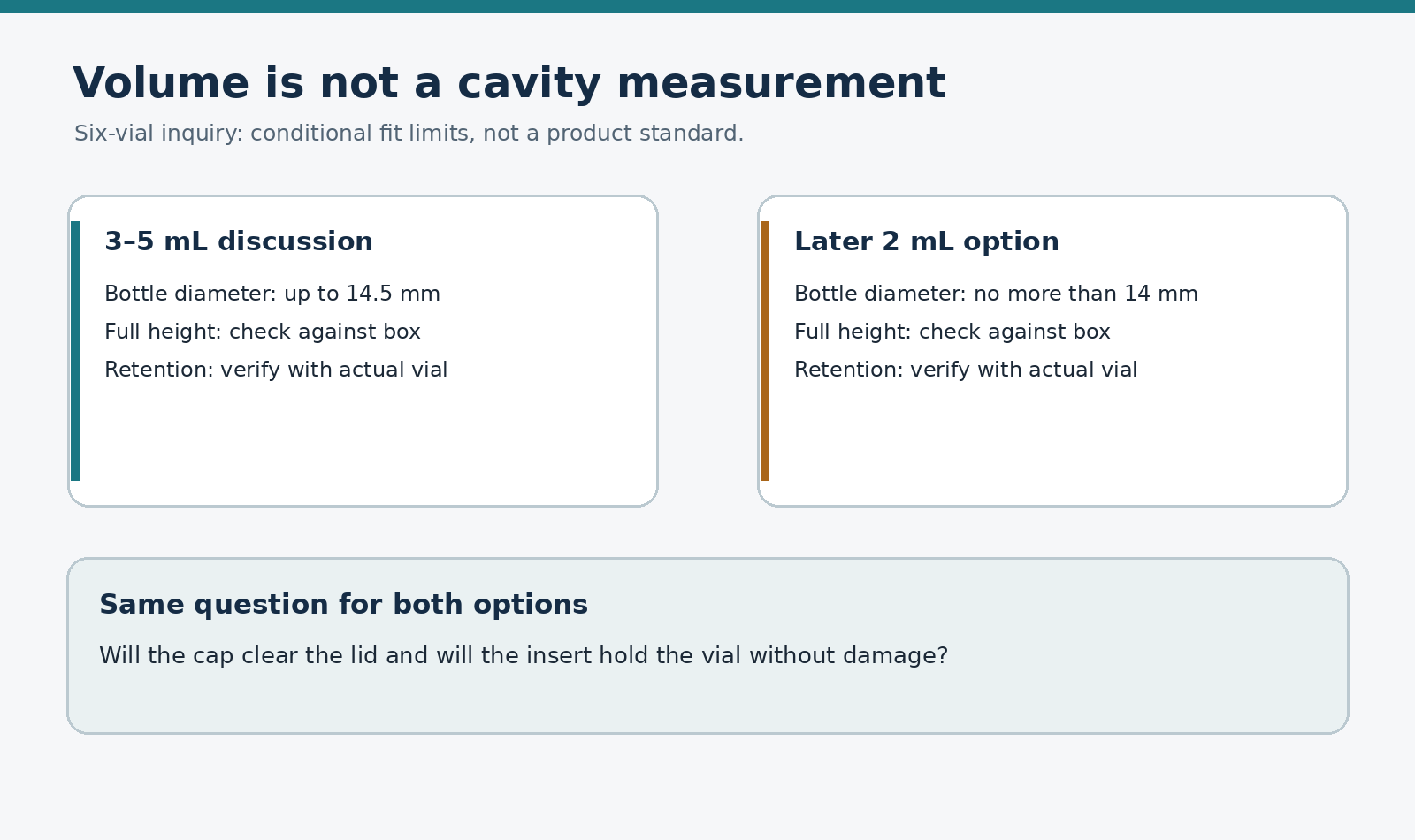
Sometimes, but volume alone cannot answer it. The filled volume describes the liquid, while the insert meets the outside of the container. Two vials sold at different capacities can have similar outer diameters, and two vials with the same capacity can have different caps or heights. A cavity that accepts the diameter still needs to hold the vial securely and let the lid close.
Inquiry 2: Six-vial sample set. In a separate conversation about six-vial boxes, a 3–5 mL option was discussed with an upper bottle-diameter limit of 14.5 mm. The later question was whether a 2 mL vial could work. The stated condition for that option was a diameter of no more than 14 mm, with bottle height checked as well. This did not establish that any 2 mL vial fits, that the fit was physically tested, or that the five-vial format from Inquiry 1 has the same cavity. No order minimum was confirmed for this six-vial inquiry.
To check an existing sample box, send the vial with its cap or sprayer attached, and record the widest diameter, overall height, shoulder shape and any label that changes the contact area. Ask how the cavity grips the vial, whether it can be removed comfortably, and whether the closed lid presses on the cap. LEETOP’s discovery set information likewise identifies diameter, height, finger access and closing clearance as layout decisions.
What if I know the perfume bottle size but not the box size?
Do not convert bottle measurements directly into a finished box size. The cap may be wider than the body, and the insert material, support points, finger access, box construction and closing clearance all affect the interior. Outer dimensions follow after the structure is chosen. A supplier can discuss directions from a drawing, but a physical product or production-equivalent bottle is valuable before approving fit.
Inquiry 3: One cylindrical bottle. A packaging buyer described a cylindrical perfume bottle as 125 mm high × 50 mm in diameter and asked about roughly 300–500 boxes. Those two dimensions were useful starting data, yet the inquiry did not establish the widest capped dimension, insert design or a final box size. It would be misleading to publish a made-up finished box measurement as the buyer’s approved specification. A useful next response would request a capped-bottle photo or sample, the filled weight, preferred box style, whether an insert is required, the order quantity and delivery destination before defining the quote.
This single-bottle problem differs from a multi-vial cavity check. Perfume box dimensions explains the broader measurement sequence; here the decision is whether an existing physical format can be retained at all. If the finished bottle needs its own support geometry, compare a folding carton with an insert and a rigid presentation box using the same bottle and delivery brief. LEETOP describes custom inserts and box styles for those routes.
What should I send to compare fixed and custom options?
Use one specification for both quotes so a low minimum on an existing structure is not compared with an incomplete custom quote.
- Product: One photo or drawing of each assembled vial or bottle; maximum diameter or width and depth, full height with cap, weight, and any projecting parts.
- Layout: Number of bottles, their orientation, whether sizes are mixed, the insert material if known, and how buyers should remove each item.
- Existing option: Actual sample or dimensions of the proposed box and cavity; confirm which dimensions and print areas are fixed.
- New option: Desired presentation, proposed insert and box structure, quantity tiers, artwork status, and whether a physical fit sample is included.
- Quote scope: Box, insert, printing, bottles or labels if needed, sample costs, delivery destination and shipping basis, listed as separate items when appropriate.
For an initial request to LEETOP, send the assembled bottle dimensions, bottle count, target quantity, reference box or image, and destination. Ask for the existing-format route and the custom-fit route on the same contents. A reply can then identify which structure is feasible, what still needs a physical sample, and the minimum and cost for the specified route. Start with the fragrance packaging inquiry page.