Ordering 1,000-10,000 custom cosmetic packaging boxes is where packaging starts to become a procurement decision, not just a sampling decision. At this volume, a low factory unit price is useful, but it is not enough. You also need to know how long the inventory will last, whether the structure is using more material than necessary, how the boxes will be packed for export, and what the order will cost when it reaches your door.
For this guide, “mid-volume” means roughly 1,000-10,000 boxes per SKU or production run. It is a practical buying range, not an industry-standard definition. The best order quantity is the one that gives you a competitive delivered cost without leaving you with months of packaging you may later need to change.
A good way to buy at this volume is to keep the specification fixed, request several quantity tiers, compare the same delivery basis, and only then look for structural savings.
What Changes When You Order 1,000-10,000 Custom Boxes?
At 1,000-10,000 units, unit cost, inventory risk and repeatability all matter at the same time. You are usually past the “Can this be made?” stage and closer to “Can this be reordered consistently at a sensible total cost?”
Four questions become more important as volume grows:
- What does each box cost at the quantity we are actually likely to buy?
- How many months of packaging will that quantity create?
- Can the same structure be repeated without rebuilding the project from scratch?
- How much freight and storage are we paying for because of the box size and packing method?
Quantity changes unit price because setup work such as printing preparation, cutting dies, sampling and production planning is spread over more finished pieces. LEETOP’s guide to custom packaging MOQ explains why the workable minimum depends on the actual structure, material and process rather than one universal factory number.
But a lower unit price does not always mean a lower business cost. A 10,000-piece quote can look attractive until you convert it into months of stock and realize the artwork, bottle or retail requirement may change before the inventory is used.
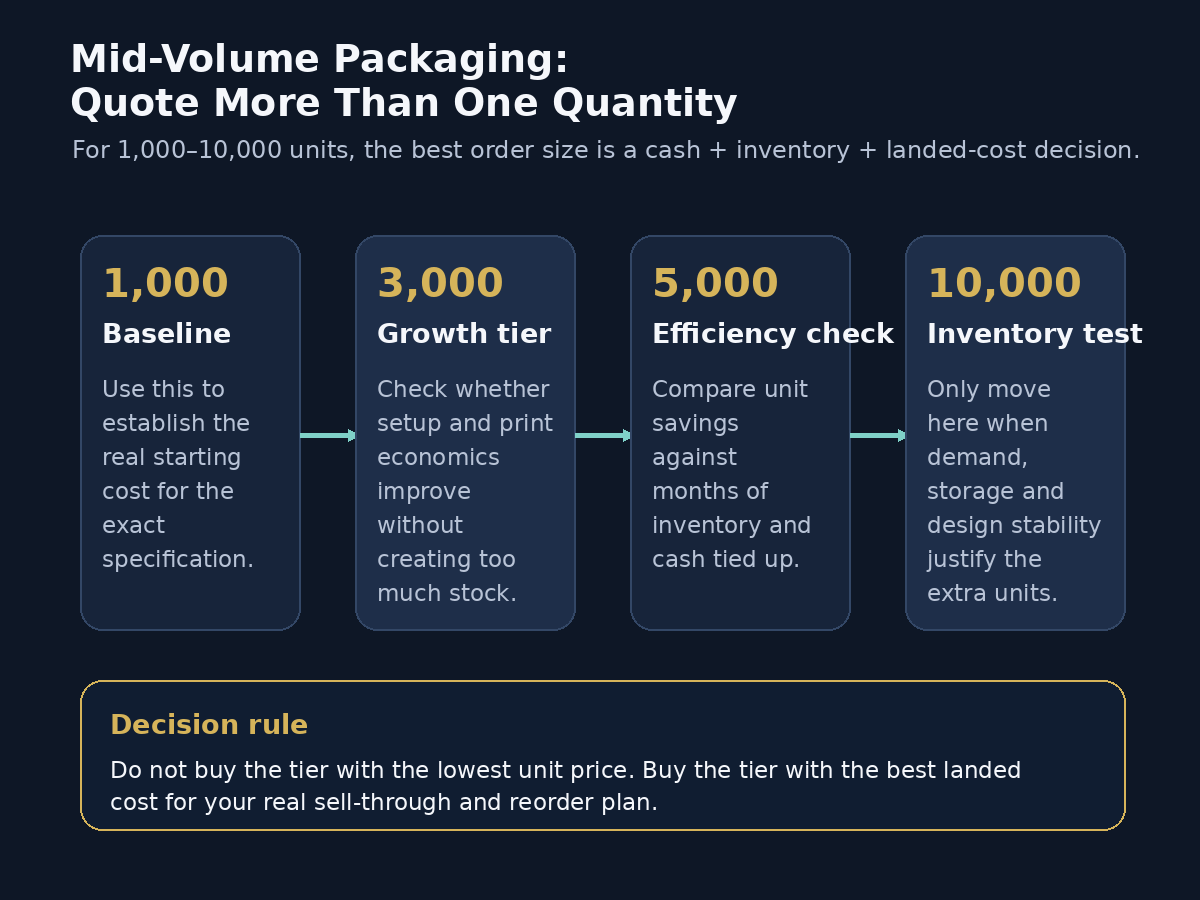
Ask for the Same Specification at 1,000 / 3,000 / 5,000 / 10,000 Units
For a growing SKU, ask the supplier to price the same box specification at several quantities. A useful starting set is 1,000 / 3,000 / 5,000 / 10,000 units when the production route supports those tiers.
Keep the dimensions, board or paper, print, finish coverage, insert and delivery basis unchanged. If one tier uses a thinner board or a different insert, it is no longer a clean quantity comparison.
Then translate each quote into inventory months.
Illustrative example: if you use 1,500 boxes per month, 3,000 pieces cover about 2 months, 5,000 cover about 3.3 months, and 10,000 cover about 6.7 months. The 10,000-piece tier may have the lowest price per box, but that saving is only useful if the packaging is stable enough to sit in inventory for that long.
Before choosing a tier, check:
- Expected monthly usage
- Reorder lead time
- Available storage
- Cash tied up in packaging
- Likelihood of artwork, product or regulatory changes
- The actual saving from moving to the next quantity tier
For a stable bestseller, a deeper order may be reasonable. For a SKU that is still changing, paying slightly more per box can be cheaper than replacing several thousand obsolete boxes.
Choose the Box Structure Before You Negotiate the Price
If the structure is wrong for the product, negotiating the unit price will not fix the underlying cost.
Folding cartons are usually the efficient retail option
A custom folding carton is often the first structure to evaluate for serum bottles, cream jars, lip products, small fragrance bottles and other individual retail units. It ships flat, uses less material than a rigid box and can still carry full-color printing, foil, embossing, spot UV and laminated finishes.
For many beauty products, the bottle or jar already provides most of the physical protection. The folding carton then handles branding, shelf presentation and secondary protection without adding the shipping volume of an assembled rigid box.
Rigid boxes make more sense when the presentation is part of the product value
A custom rigid box is a better fit for perfume sets, discovery sets, premium skincare kits, limited editions and other products where the opening experience matters.
Choose the rigid structure around the actual use. Magnetic, lid-and-base, drawer and foldable rigid boxes create different opening motions, packing volumes and costs. LEETOP’s rigid box cost guide explains how dimensions, board, wrap paper, finishes, inserts, quantity and packing method affect the finished box.
You do not need the same premium structure for every SKU
A practical brand system may use folding cartons for everyday retail products and rigid boxes only for gift sets, launches or higher-value bundles. That keeps the expensive structure where customers notice it instead of adding it to every unit sold.
Where Mid-Volume Packaging Costs Actually Move
When a project is already in the thousands of units, the useful cost conversation is usually about the specification, not a generic discount request.
1. Box size
Build the box around the real product dimensions, including the cap, pump, tolerance and the way the product needs to be removed. Oversized packaging uses more paper or board, creates a larger insert and takes up more space in master cartons and storage.
This is especially important for rigid boxes because many rigid structures ship assembled. A small reduction in finished size can affect material use and freight at the same time.
2. Insert design
The insert can quietly make the whole package larger. Wide borders, deep foam blocks and oversized cavities all add volume.
Use the custom insert material that fits the product and presentation requirement. EVA, other foams, paperboard and molded pulp solve different problems. The right choice is the one that holds the product securely without forcing the outer box to become larger than it needs to be.
3. Finish coverage
Foil stamping, embossing, debossing, spot UV, specialty papers and lamination can all add value, but every extra process also adds setup and quality-control work.
For many mid-volume projects, one finish used deliberately is stronger than stacking several effects across the whole package. A foil logo or a controlled embossed detail can do more for the presentation than adding every available process.
Review materials and finishes after the structure is settled. It is easier to control cost when finishing is added to a box that is already the right size and construction.
4. Standardization across SKUs
If several SKUs can share the same board grade, paper family, finish, structural platform or insert material, repeat orders become easier to manage.
The artwork does not need to be identical. The point is to avoid changing technical details that customers do not see unless there is a good reason to change them.
5. Like-for-like comparison versus redesign
These are two separate decisions and they should stay separate.
Like-for-like comparison: match the current dimensions, material, board thickness, print, finishes, insert and delivery basis. This shows whether another supplier can produce the same specification at a different total cost.
Structural optimization: deliberately change the size, insert, finish coverage, packing method or another specification to reduce cost while keeping the required appearance and protection.
If both are mixed into one quote, it becomes difficult to tell whether the lower price came from better sourcing or simply from changing the product. LEETOP’s packaging cost comparison starts with the matched specification and shows any proposed design or structural changes separately.
6. Export packing
Before production is locked, ask how the finished boxes will be packed for shipment: units per export carton, carton dimensions, gross weight and total shipment volume.
This is not a detail to leave until the goods are finished. A package that looks efficient on the product level can still be expensive to move if the export cartons are carrying a lot of unused space.
What Does Landed Cost Include for Imported Packaging?
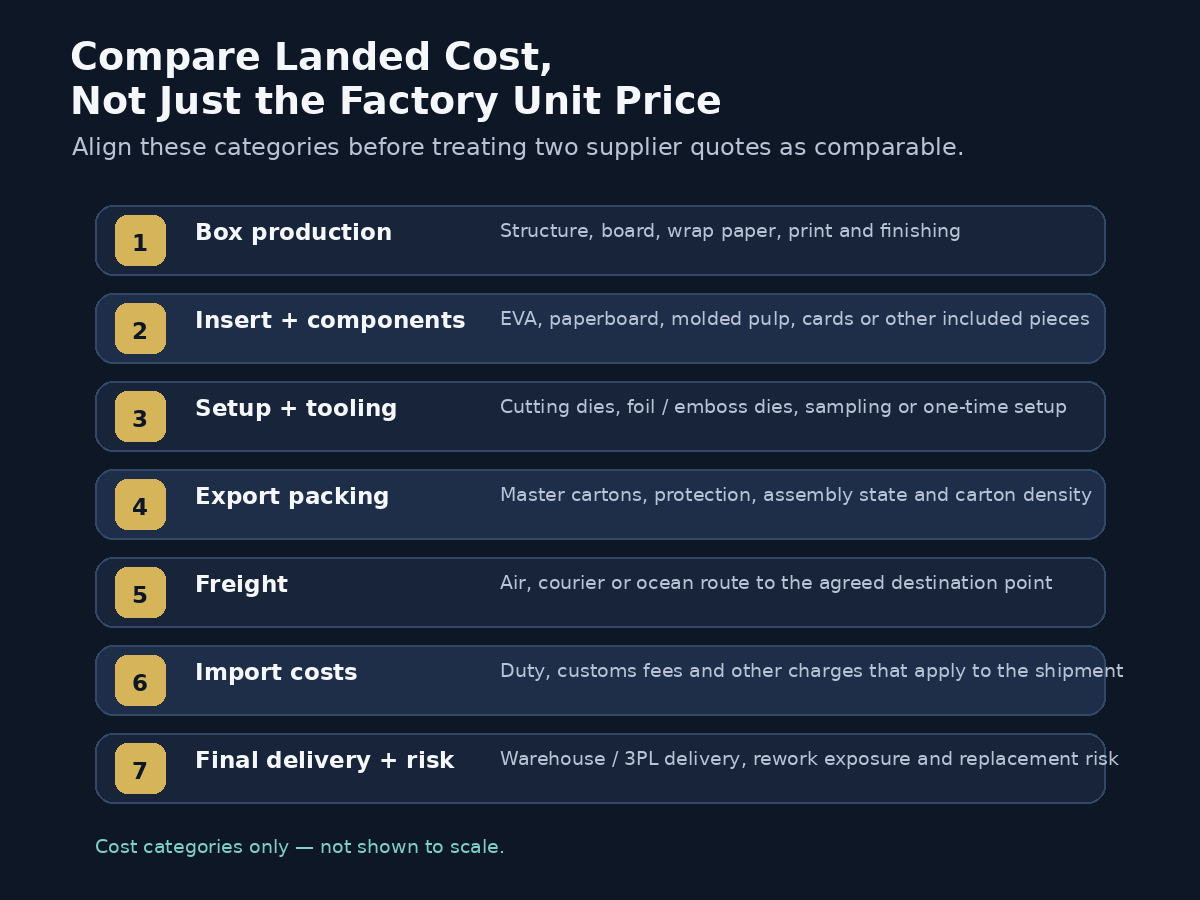
Landed cost is the cost of getting the packaging to the agreed destination, not just the factory price of the box. The exact items included depend on the trade and delivery terms used in the quote.
For a supplier comparison, review the same commercial basis for:
- Packaging production
- Inserts and other components
- One-time sample, die or tooling charges where applicable
- Export packing
- International freight
- Import duties, taxes or fees where applicable
- Customs or clearance costs where applicable
- Final delivery to the agreed destination
The International Chamber of Commerce explanation of Incoterms 2020 is useful for understanding which party is responsible for particular obligations, costs and risks. For U.S. imports, U.S. Customs and Border Protection explains that imported goods can be subject to duties and user fees depending on the shipment and entry.
Shipping volume matters as well. FedEx explains dimensional-weight pricing, where the space a package occupies can affect the charge even when the actual weight is low. That is one reason oversized packaging can stay expensive long after the box leaves the factory.
LEETOP’s guide to importing custom packaging from China to the USA covers the same buying sequence: align the specification, approve the sample, confirm the delivery term and compare quotes on the same basis.
How Do You Compare Two Packaging Suppliers Fairly?
Put both suppliers on the same written specification before comparing the totals. If the specifications are different, the prices are not directly comparable.
Confirm the following on both quotes:
- Finished box dimensions
- Box structure
- Board or paper grade and thickness
- Wrap paper where applicable
- Printing process and color requirements
- Lamination or coating
- Foil, embossing, debossing, spot UV and other finishes
- Insert material and cavity layout
- Quantity
- Sample and tooling charges
- Export packing method
- Production lead time
- Delivery term
- Delivery country and ZIP or postal code
If a supplier believes a cheaper structure will work, keep it as a separate option. You should be able to see one price for the package you asked for and another price for the proposed cost-saving version.
That makes the decision much cleaner: same package at a different cost, or a deliberately different package at a different cost.
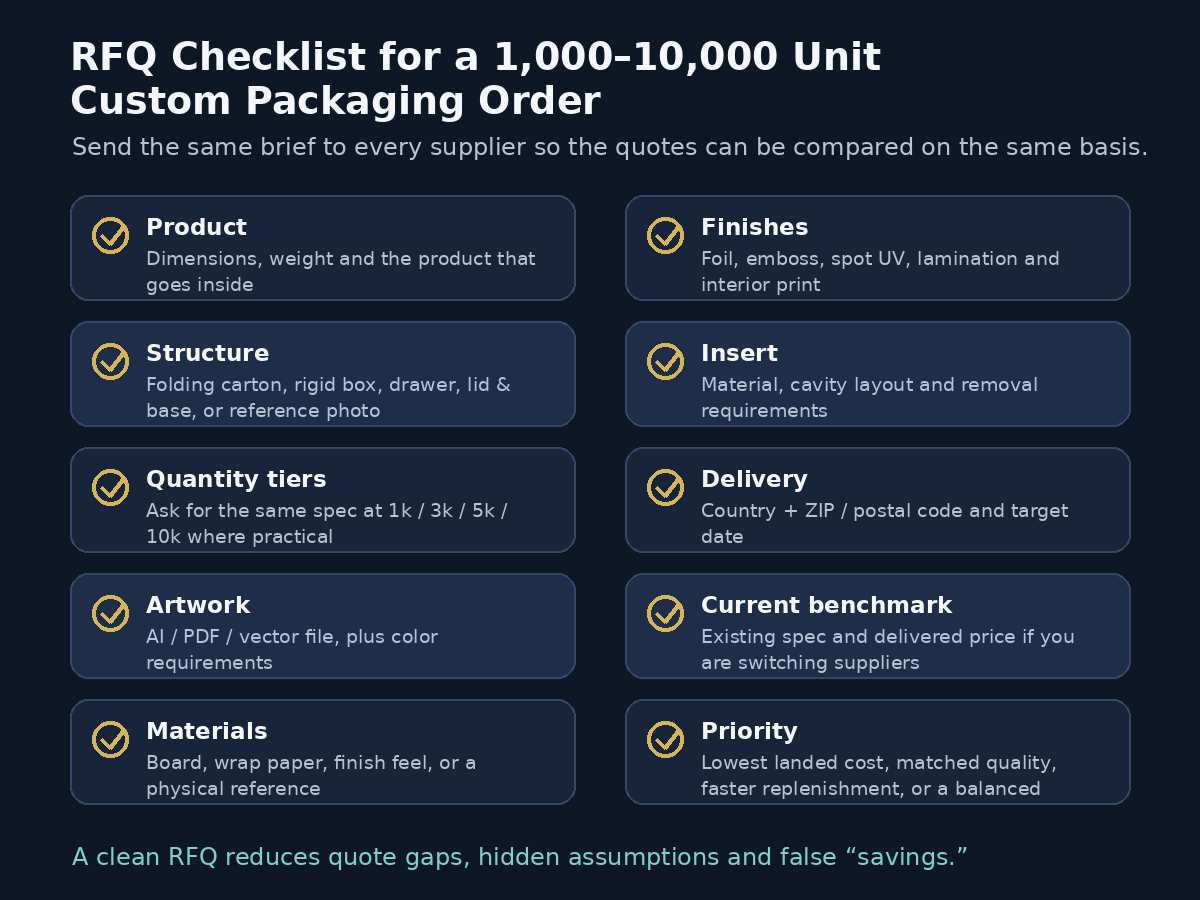
What Should You Send for a 1,000-10,000 Unit Packaging Quote?
A supplier can quote faster and more accurately when the buying brief is specific.
Send:
- Product dimensions and approximate weight.
- Target box structure or a clear reference image.
- The quantity tiers you want quoted.
- Artwork, dieline or AI-generated concept if available.
- Required material direction or a physical reference you want matched.
- Finishing requirements and approximate coverage.
- Insert material, product layout and removal requirements.
- Delivery country, ZIP or postal code, and target date.
- Existing packaging specification and delivered price if you are comparing suppliers.
- Your priority: lowest landed cost, matched quality, easier repeat orders, faster replenishment, or a balanced target.
An AI rendering or reference image is useful for communicating the visual direction, but production still needs confirmed dimensions, structure and print-ready artwork before mass production. The earlier those technical details are fixed, the more useful a 5,000- or 10,000-piece quote becomes.
Who Is This Buying Approach For?
This approach is most useful for beauty and fragrance brands that have moved beyond a small validation run and now need a repeatable packaging supply.
It is a good fit when you:
- Buy roughly 1,000-10,000 boxes per SKU or production run
- Already have a selling product or production-ready launch
- Expect repeat orders
- Need folding cartons, rigid boxes, fitted inserts or coordinated packaging sets
- Want to compare an existing supplier on the same specification
- Want a China production quote that also shows delivery options for the U.S. or Canada
If you are still testing a new concept and want the smallest possible commitment, the brand launch and test kit route is more appropriate. The priorities are different when flexibility matters more than volume efficiency.
FAQ
How much does custom cosmetic packaging cost at 1,000 units?
There is no useful universal price for 1,000 custom cosmetic boxes. Cost depends on finished size, structure, paper or board, printing, finish coverage, insert, packing method and delivery destination. The reliable way to compare pricing is to quote one fixed specification at several quantities.
Is 10,000 units always cheaper than 5,000 units?
The unit price is often lower at the larger quantity, but the larger order is not automatically the better buy. Compare the saving with inventory months, storage, cash tied up and the chance that the product or artwork changes before the boxes are used.
Do I need a rigid box for premium cosmetic packaging?
No. Folding cartons can look premium when the material, printing and finishing are well chosen. Rigid boxes are more useful when structure, presentation and the opening experience are part of the product value.
What is the difference between factory price and landed cost?
Factory price is the supplier’s production price under the quoted commercial terms. Landed cost looks at the broader cost of getting the packaging to the agreed destination, including the relevant freight, import and final-delivery costs that apply to that shipment.
Can I use an AI packaging design to request a quote?
Yes. An AI concept image can communicate the desired look and help start the structural discussion. Before production, the supplier still needs confirmed dimensions, materials, structure and production-ready artwork or dieline files.
Can several cosmetic SKUs share one packaging system?
Often, yes. Several SKUs may share the same material family, finish, structural platform or insert route while using different artwork. Whether they can share the exact same finished size depends on the products being packed.
What should I send if I already have a packaging supplier?
Send the current box dimensions, material specification, finish details, insert information, order quantity, delivery destination and current delivered price if available. That allows a like-for-like comparison before any redesign is proposed.
Buying 1,000-10,000 Units? Compare the Same Package First
If you already have a box, dieline, artwork or current supplier quote, send it with the target quantity and delivery destination. LEETOP can price the matched specification first and show any structural or packing changes separately, so you can see exactly what changed and why.
Compare your current packaging cost or request a custom packaging quote.