Sustainable cosmetic packaging is a purchasing goal that needs a specific definition. For a paper outer box, useful questions include how much material it uses, what that material contains, whether components can be separated, and what recycling route exists where the package is sold. A brown surface, a paper insert, or a certification logo does not answer all four.
This guide helps beauty brands compare secondary paper-packaging options and collect evidence for the claims they intend to make. It does not assess the formula, bottle, or complete product life cycle.
Define the improvement before choosing the material
Begin with one or two measurable priorities. For example, you might want to reduce the outer carton's weight, remove a plastic window, specify documented recycled content, or make a removable insert easier to separate.
State the boundary. “Reduce the weight of the outer carton” is a different project from “reduce the environmental impact of the complete cosmetic product.” A lighter box is measurable; a lower total environmental impact requires a broader comparison.
The FTC's summary of the Green Guides cautions against broad, unqualified environmental benefit claims. Prefer a clearly defined attribute that can be substantiated for the actual packaging supplied. Do not treat a general supplier brochure as evidence for every finished order.
Map the entire outer packaging assembly
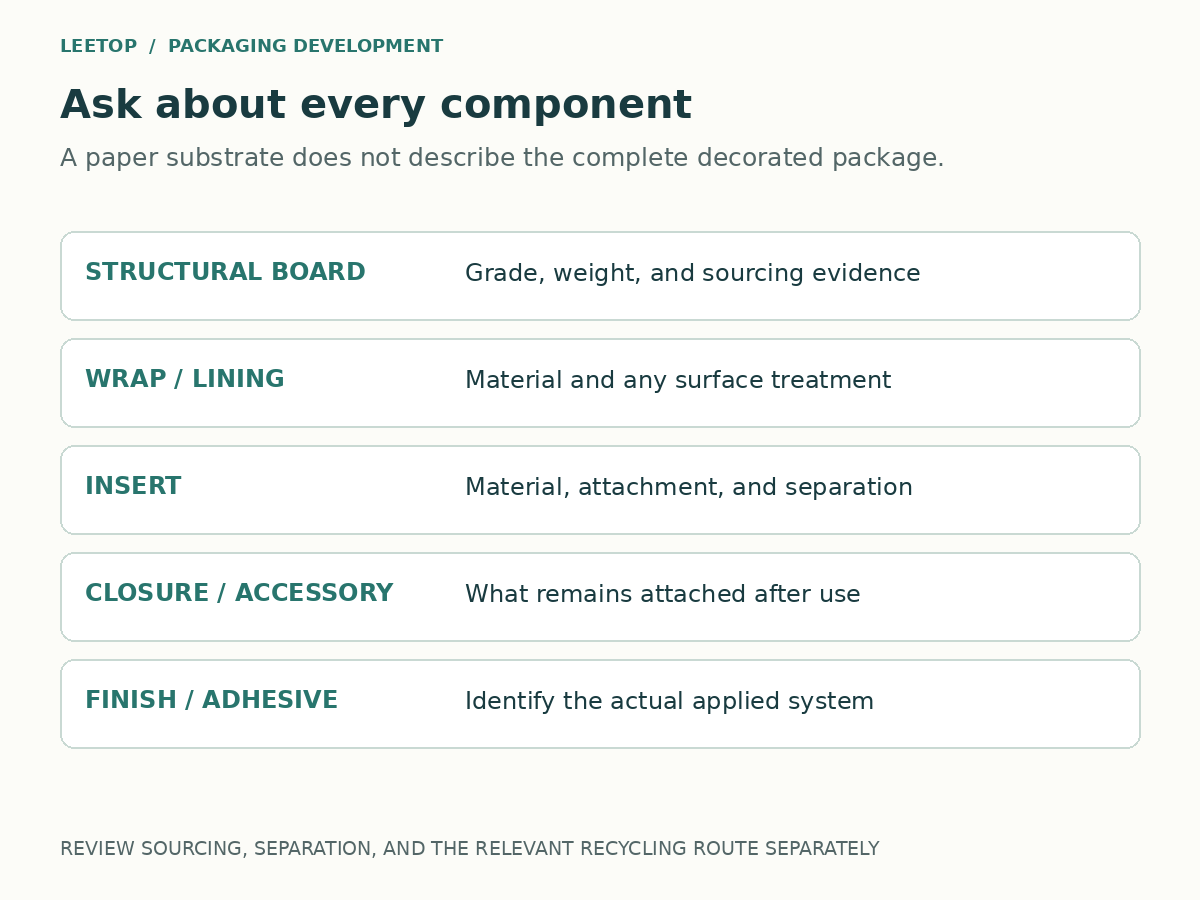
List the components before comparing material names. A rigid presentation box may include structural board, outer wrap, lining, an insert, adhesive, a ribbon, and a closure. A folding carton may have fewer parts but still include a coating or window film.
For each component, record its function, material description, whether it is permanently attached, and what evidence is available. Ask the supplier to identify finishes and adhesives that are absent from the artwork but present in production.
The AF&PA Design Guidance for Recyclability overview explains that non-fiber elements, including coatings and additives, can affect paper-packaging recyclability. That is a reason to evaluate the finished assembly, not to assume that every coating has the same effect.
A useful development request is: “Show which parts can be removed without tools, and identify anything that remains bonded to the paper structure.” Then physically attempt the separation on the proposed sample.
Keep recycled content and recyclability separate
Recycled content describes material used to make the packaging. Ask for the percentage, the component it applies to, and supporting documentation for the supplied grade. Where relevant, distinguish pre-consumer and post-consumer content rather than leaving the term undefined.
Recyclability concerns the package after use. Collection, sorting, processing compatibility, and access to suitable programs matter. A material may contain recycled fiber without the complete decorated package being accepted through a particular local route.
The FTC's consumer explanation of environmental claims also distinguishes claims about the product from claims about its package. Keep that distinction visible in the copy. Evidence about the carton should not be presented as evidence about the formula or bottle.
Ask the brand's claims reviewer to check the wording against the intended sales markets. Adding a vague “check locally” statement is not a substitute for evaluating whether the main claim is supportable.
Understand what an FSC label establishes
FSC offers different labels for different material sourcing categories. Its label explanation distinguishes FSC 100%, FSC Mix, and FSC Recycled. FSC Mix should not be read as a promise that the package is made entirely from recycled material.
A sourcing label also does not by itself establish curbside recyclability, compostability, or a lower carbon footprint for the complete pack.
If an FSC label is part of the brief, follow the FSC on-product labeling process. Confirm the relevant certified supplier, product eligibility, and label approval route. Do not copy a logo from a website into the artwork or assume that a paper mill's certificate automatically covers the final converted packaging.
For a LEETOP project, ask for the available sourcing route and documents before making a certification claim. This article does not assert that every LEETOP package is certified.
Compare changes while preserving the pack's job
Several design changes are worth evaluating, depending on the product and required presentation:
- Remove a decorative layer that does not contribute to containment, protection, or necessary information.
- Reduce unused space while preserving product clearance, readable panels, and a practical packing process.
- Develop a paperboard support that can perform the required positioning task.
- Make a non-paper accessory removable where the construction allows it.
- Assess the actual coating and decoration system instead of specifying a finish only by its marketing name.
These are development options, not universal instructions. A material change that causes damaged products, repeated repacking, or an unusable opening needs reconsideration. Compare the options with the same product load and acceptance requirements.
The 4evergreen Circularity by Design guidance addresses different recycling pathways and the effects of design on sorting. Its European framework is a useful technical reference; it should not be presented as automatic proof of acceptance in a US municipal program.
Make a limited claim from a measured comparison
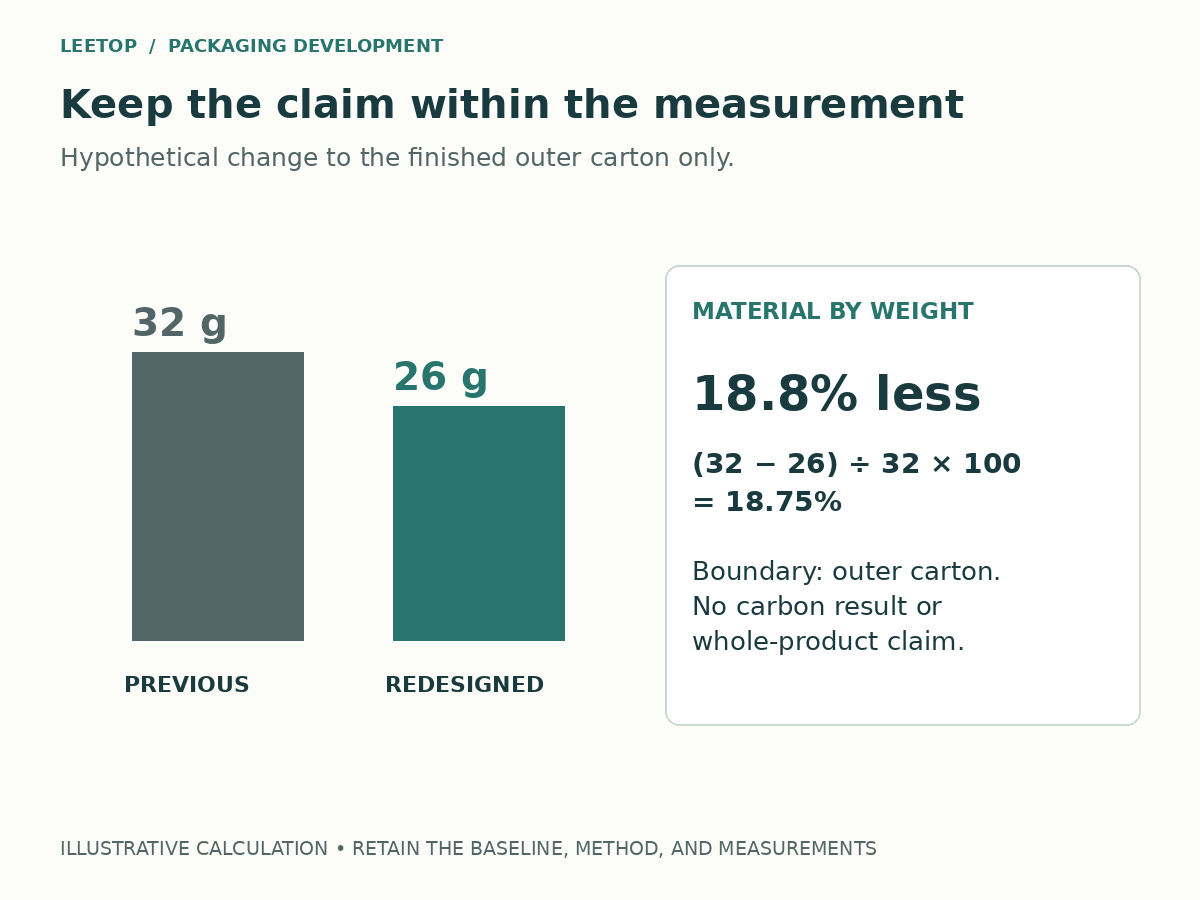
Consider a hypothetical redesign in which an outer carton weighs 32 g before the change and 26 g afterward, measured on a comparable finished-carton basis.
Carton weight reduction = (32 − 26) ÷ 32 × 100 = 18.75%, or approximately 18.8%.
A defensible comparison would name the component and baseline, subject to evidence and review: the new outer carton uses approximately 18.8% less material by weight than the specified previous version. The supplier and brand should retain the measurements, version identifiers, and method.
That calculation does not show an 18.8% reduction in carbon emissions, total product impact, or household waste. The bottle, insert, shipping pack, production losses, and distribution are outside the example.
Ask for an evidence packet with the proposal
Request a component list, material grade descriptions, the basis for any recycled-content percentage, the proposed finish system, and applicable certification documents. If the supplier references testing, check that the report covers the relevant construction and that the conditions match the claim being considered.
Keep the approved claim wording with the packaging specification. A later change to a coating, insert, closure, or paper grade should trigger a review of both the physical package and its environmental statements.
LEETOP's materials and finishes overview is a starting point for discussing alternatives. The selected grade, construction, and documentation should be confirmed for the individual project.
Questions about sustainable beauty boxes
Is kraft paper automatically more sustainable than white paperboard?
Color alone does not establish fiber sourcing, recycled content, material efficiency, or end-of-life performance. Compare the documented grades and the complete structures against a defined goal.
Does a paper insert make the whole package recyclable?
No. Review all attached materials, the assembled construction, and the relevant collection and processing route. The insert is one part of the assessment.
Can a smaller box be advertised as lower carbon?
A size or weight reduction alone does not establish a carbon-footprint result. Keep the claim within the comparison you have measured unless a suitable wider assessment supports more.
Start with a specific change
Send LEETOP your current packaging photos or sample, product requirements, sales markets, and the improvement you want to evaluate. Include the environmental wording you hope to use so the required evidence is identified early. Request a materials review before committing the claim to print.