To size a shipping carton for a rigid gift box, put the actual product in its insert, close the gift box, fit the proposed cushioning and measure the wrapped pack at its widest points. Give those measurements to the carton maker and ask for a trial carton with stated inside dimensions. Quote one carton and its cushioning per customer shipment. Ask separately for the master cartons used to deliver empty presentation boxes to your warehouse. They carry a different load, on a different journey, and buying one does not automatically buy the other.
A brand asked us for both prices. It planned to receive the presentation boxes empty, load the product locally and send each finished gift to a customer. We proposed flat shipping cartons and two widths of expanded polyethylene foam, or EPE, cut from rolls at the packing bench. There was a catch: the cartons could travel flat, but the rolls would still occupy freight space. We kept that freight estimate open pending packed dimensions. Here is how to decide which parts of that proposal belong in your own order.
Give the warehouse two distinct packing specifications
Start with a sketch of what arrives at your loading dock. You might receive several empty gift boxes in one export carton, with dividers or interleaving chosen to protect their printed surfaces. Now draw what leaves your warehouse for a customer. That parcel contains one presentation box, its insert, the product, any cards and the protective material around the closed box. The return address, shipping label and sealing tape normally belong on the outside carton. Mark the number of retail boxes inside each type of carton. That single detail makes the two drawings hard to confuse.

Ask your supplier to put the two specifications on separate lines. For the inbound shipment, request the count of empty boxes per master carton and its gross weight. For the outbound parcel, request one assembled sample of the individual shipper, the exact cushioning pieces and the packed unit weight. A line that reads “export packing included” still leaves a question for your fulfillment team: what material will it have on hand to pack the first customer order?
Measure the gift box with the cushioning in place
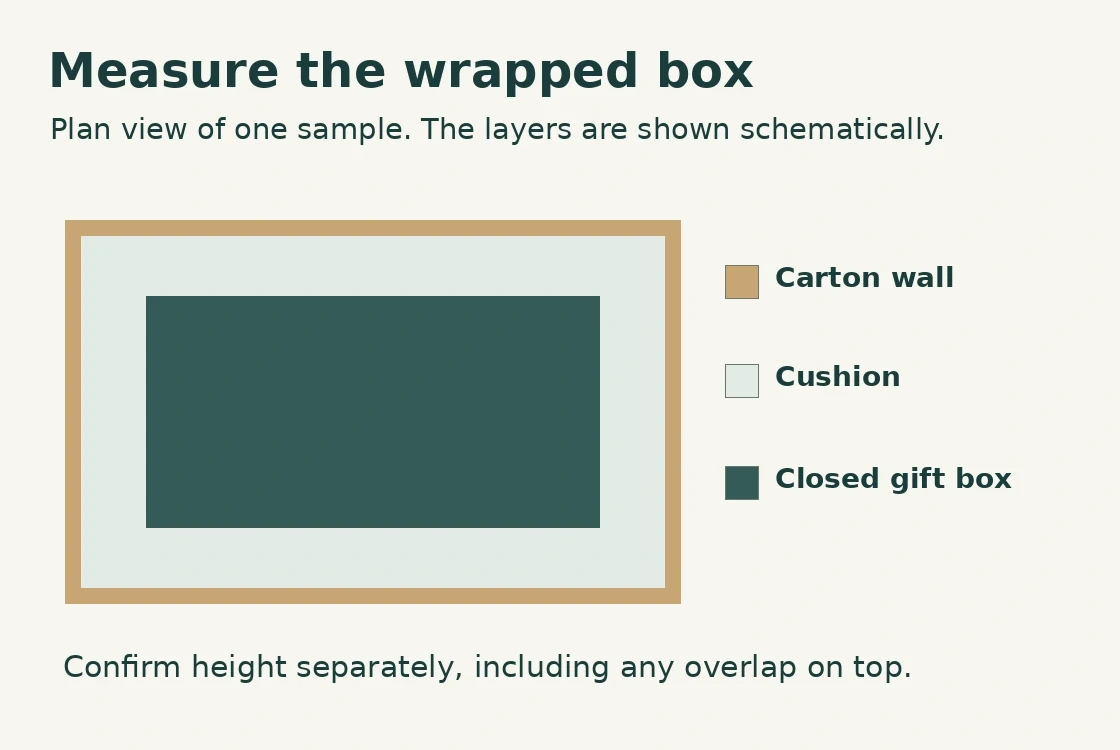
Place the loaded gift on a level surface and record its closed outside length, width and height. Include a projecting lid edge, ribbon knot or raised decoration if it changes the envelope. Weigh it with everything that will go to the customer. A plain empty sample can establish a preliminary fit, but it cannot tell you how the product’s weight will bear on the insert or the bottom of the box. If the final product is unavailable, record what you used as a substitute and which checks still need the real item.
For the first mockup, fit the proposed wrap exactly as the warehouse would. Where two strips cross, each contributes thickness. A folded end or overlap can become the highest point. Place a straightedge lightly across that point to measure the packed height without squeezing the material flat. Repeat along the length and width. Label these measurements “wrapped pack outside.” Ask the converter to specify the usable inside dimensions of the trial carton and allow enough room to load the pack without forcing it. Measure the sealed carton’s outside dimensions separately for the freight quote.
Specify foam roll width and cut length separately
On a roll, width is the distance from one side of the web to the other. Cut length is how far the operator unrolls it for a single strip. A purchase order that gives only two widths leaves the warehouse to discover both cut lengths. Make a pair of paper strips for a quick orientation check, then cut samples from the actual foam. Label one strip lengthwise and the other crosswise. Mark where the ends meet on each, keeping a seam away from artwork that could pick up a pressure line.

Wrap several packs at the bench before ordering full rolls. Write down the roll width, approved cut length and number of strips of each type per parcel. For example, if a trial uses one 0.90 m strip from roll A and one 0.70 m strip from roll B, 100 parcels consume 90 m of A and 70 m of B before trial pieces or cutting waste. That is an illustration of material usage, not a recommended wrap size. Ask whether the supplier quotes usable linear length, rolls of a stated length, or pre-cut pieces. If your team shares one cutting station across several products, time the operation once with a real packer.
Check what the customer will see after shipment
Before sealing the trial carton, photograph the loaded insert, the closed gift box, the wrapped pack and its position inside the carton. Mark the corners of the sample on a reference photo. After a representative shipment or an agreed distribution test, open the parcel in that order and compare. Look for a polished patch on textured paper, a dent under a foam overlap, a lifted lid or a product that has shifted inside an otherwise tidy box. Record which face was affected so the supplier can reproduce the problem.
If the item shifts inside the gift box, examine its inner retention first. If the gift stays seated but the cover rubs against an outer seam, revise the wrap or carton fit. Record the specific change and repeat the check with that version. A hand-fit sample helps you see how the parts assemble. For a fragile or heavy item, have the pack evaluated for the weight, route and parcel service you actually plan to use. A board description such as “double-wall,” by itself, cannot establish the protection that the finished parcel will provide.
Compare the cost of packing one customer order
Get one quote for shipping the cartons and cushioning with the retail boxes, and another for buying equivalent materials near the fulfillment site. Give both vendors the same sample specification and quantity. Ask the overseas supplier for the additional packed volume of the flat cartons and the rolls separately. Locally supplied foam may look more expensive by the roll yet cost less per usable wrapped pack after freight. Pre-cut pads may reverse that result if they reduce labor or let the warehouse avoid buying much more material than it needs.
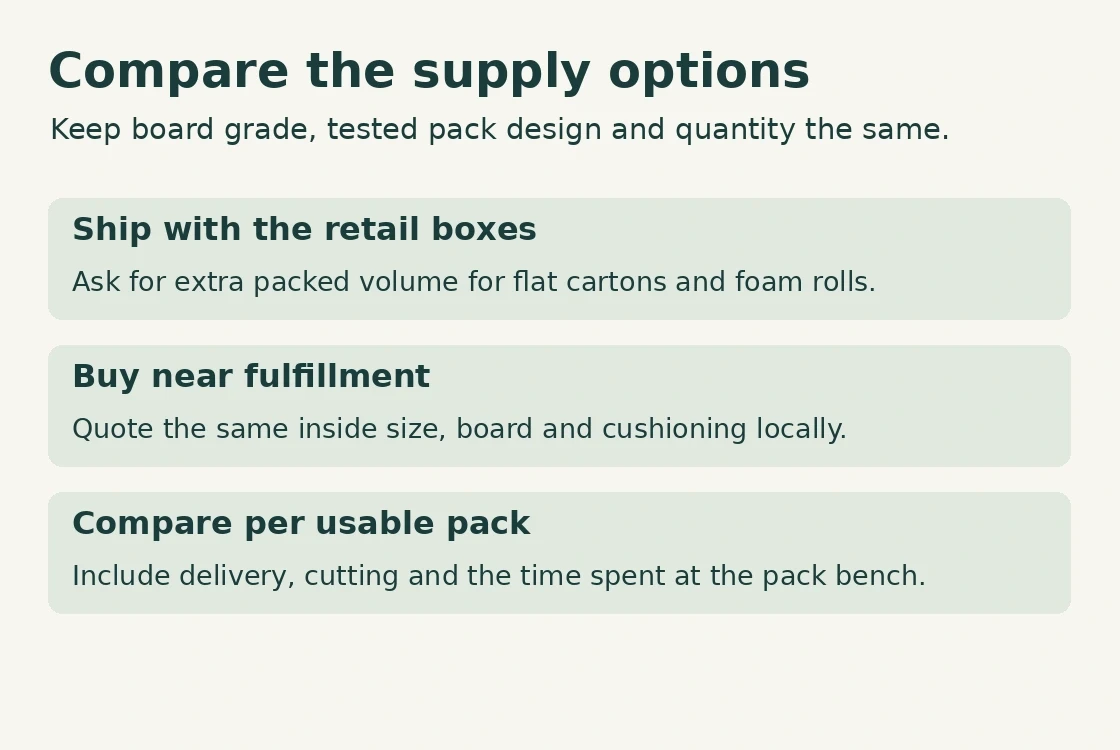
Send your ecommerce shipping packaging supplier the loaded weight, gift-box outside dimensions, wrapped dimensions, destination postal code, order quantity and sample photos. Specify who cuts the foam, who assembles the cartons and who buys the tape. If your separate question is how the empty boxes should arrive from the factory, the guide to shipping packaging flat or assembled covers that inbound decision. For the outbound order, ask for one final deliverable: a signed-off sample and a packing sheet that lets the next person on the bench reproduce it.