Rigid drawer boxes combine an outer sleeve with an inner tray that slides out. For a beauty gift set, the critical design decisions are how far that tray opens, how the customer grips it, and what prevents an unintended release. A smooth empty sample is not enough: evaluate the box with the intended products and insert installed.
This guide covers paper-based drawer packaging for cosmetics and fragrance. It focuses on the opening mechanism and usable space, rather than comparing every rigid box style.
Specify the opening direction before the artwork
Start with the closed box in the position the customer will first see. Mark the front, the intended pull direction, and which hand holds the sleeve. Then show the opened position with the actual products visible.
A portrait artwork layout and a sideways opening can work together, but the choice should be deliberate. The sleeve graphics, tray front, insert, and product labels need to agree on the intended orientation.
Decide whether the package opens while resting on a counter or while held in two hands. For a heavy jar or glass-bottle set, make sure the customer can support the moving tray. A ribbon is an opening aid; it should not automatically be treated as a carrying handle for the filled package.
The drawer box product page provides the structural starting point. The next step is to define how this particular set should open.
Treat grip, sliding fit, and retention as separate decisions
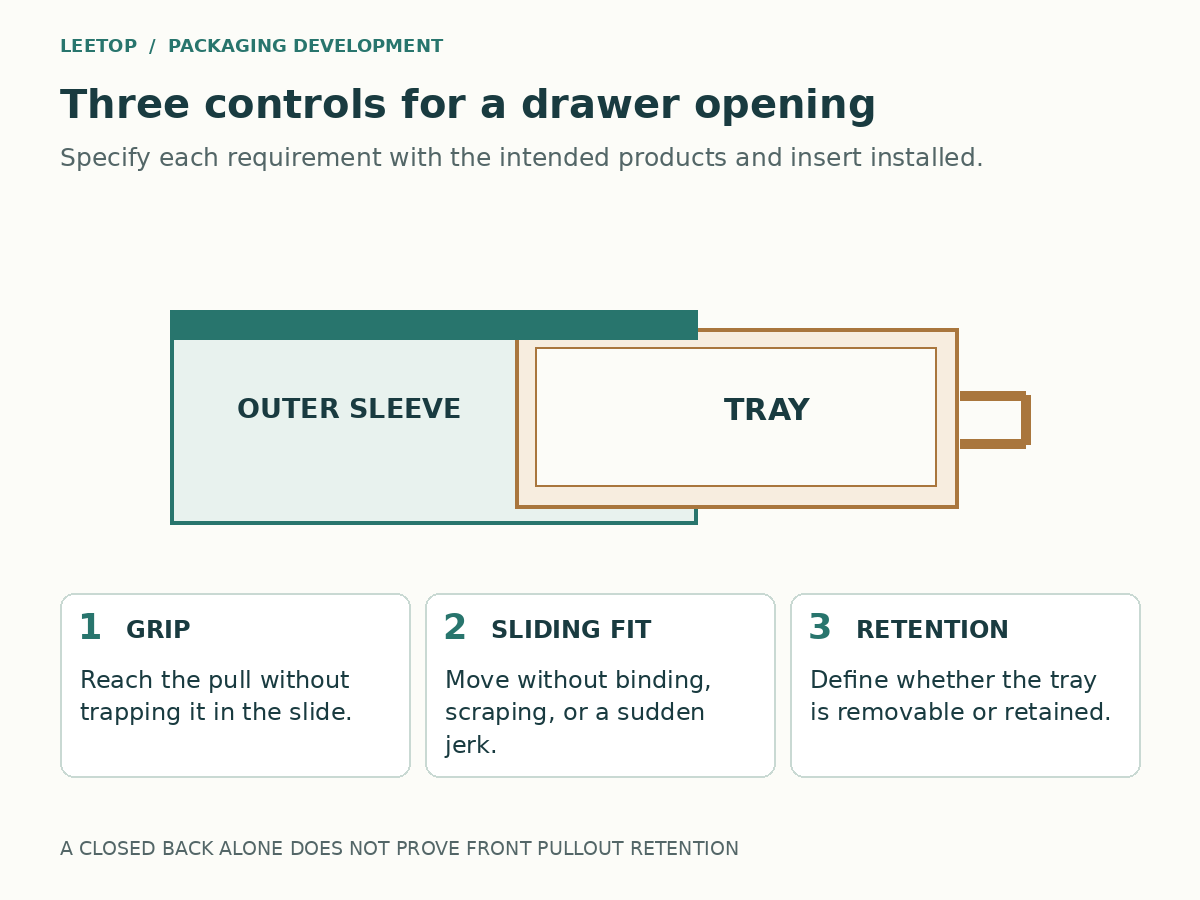
These three features solve different problems. Asking for a “premium opening” does not define any of them precisely enough.
Grip provides access to the tray
A ribbon or paper pull gives the customer something to hold. A finger notch may provide access to the tray edge or a way to push it from an accessible end, depending on the construction. Check the actual hand position and available space.
For a ribbon, review its length, anchoring, and position when the box is closed. It should not become trapped in the sliding path. For a notch, check that fingers can reach the intended surface with the insert and product present.
Sliding fit controls resistance
The fit between the finished tray and sleeve affects whether the drawer binds, scrapes, or moves too freely. Wrapped board thickness, folds, seams, and finish can affect the assembled result.
There is no single clearance that is correct for every drawer box. Agree on the intended opening behavior and inspect a sample made with representative materials. An unfinished white structural model can establish geometry, but it cannot fully represent a finished, wrapped surface.
Retention limits unintended movement
Specify whether the tray should be fully removable or retained at the intended opening position. A fully removable tray may be convenient for loading. A retained tray may support a controlled reveal, provided the products remain accessible.
Do not assume a closed back end prevents the tray from being pulled out through the front. A back wall may block travel in one direction without retaining the tray in the other. If front pullout must be limited, ask for the actual retaining feature to be shown and demonstrated.
Check the space needed to open the box
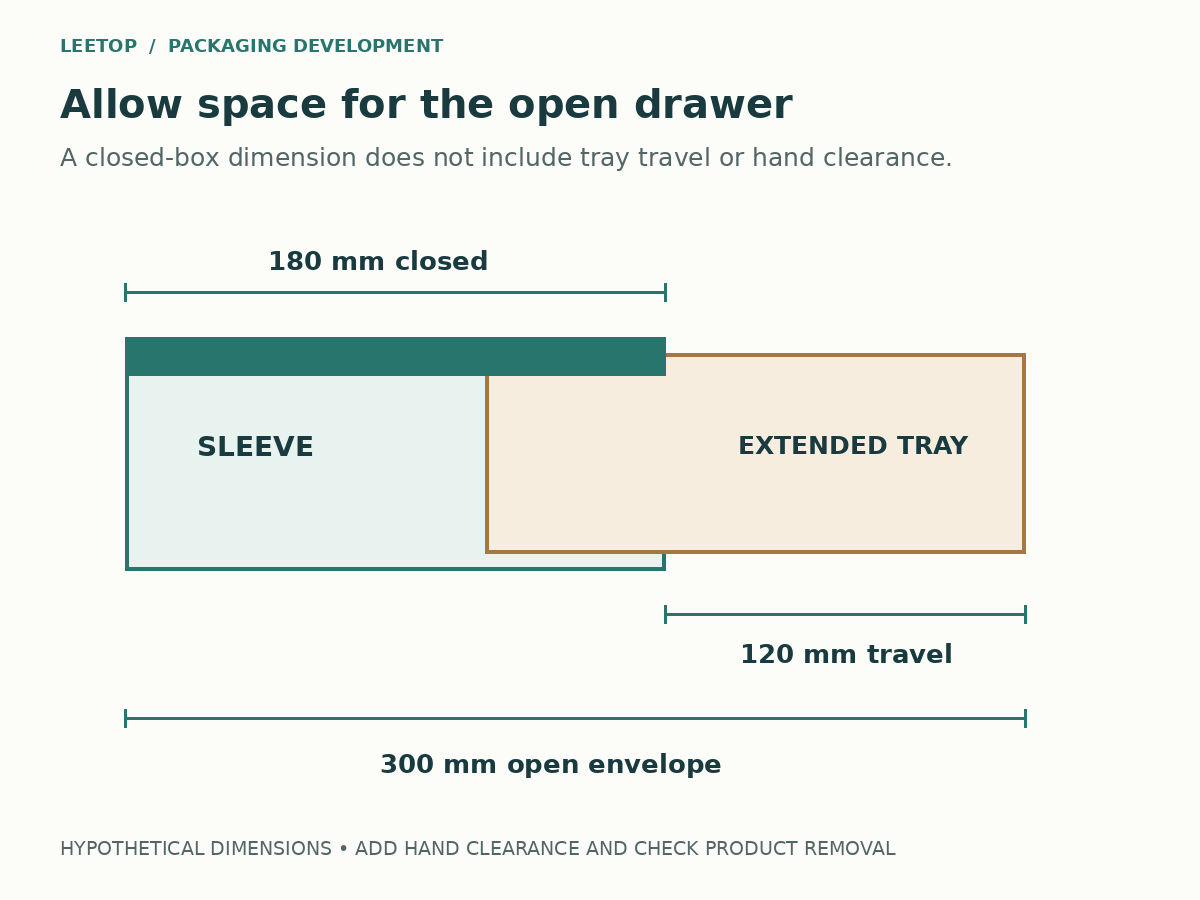
The closed footprint does not describe the full area required during use. A drawer needs extension space in its opening direction and room for the user's hand.
In an illustrative concept, the closed box occupies 180 mm along the opening direction. The proposed tray travel is 120 mm. Its open envelope along that axis is therefore approximately:
180 mm + 120 mm = 300 mm, before hand clearance.
This is a planning example, not a dieline dimension. A protruding pull and the customer's grip may need additional space. Confirm the actual geometry on the sample.
Now check whether 120 mm of travel exposes enough of the product to remove it. A tray can open attractively while leaving a jar or bottle partly trapped under the sleeve. The insert's grip openings and the product's lift path must work at the allowed extension.
For a presentation that will be opened on a narrow retail counter, this check may influence the opening direction. It can be more useful than increasing the box depth after the graphics are finished.
Keep the products below the moving clearance
When the tray closes, the highest point of the product and insert must pass beneath the sleeve's inner surface. Review the complete height, including caps, pumps, raised labels, and any decorative card sitting on top.
Avoid checking only the insert cavity depth. A bottle may sit higher than expected, or a card may lift at an edge. Close the loaded sample slowly and observe where contact occurs. If there is interference, revise the height relationship or internal arrangement rather than forcing the drawer shut.
The insert should also remain in the intended position while the tray moves. Check whether pulling the drawer causes an unrestrained insert to shift or whether removal of one product dislodges another. Use the custom insert development options to address the specific movement, rather than selecting a material from appearance alone.
Use an acceptance record for the opening mechanism
Agree on the inspection conditions before approving production. A useful record includes the final product load, opening orientation, representative material build, and the number of opening cycles chosen for the project. Do not present a chosen cycle count as a universal industry standard.
During the trial, record these observations:
- Whether the intended pull is visible and easy to grasp.
- Whether the drawer moves without a sudden jerk, binding, or visible scraping.
- Whether any retaining feature engages at the agreed position.
- Whether the customer can remove every product at that position.
- Whether repeated opening changes the seam, ribbon anchoring, surface, or sliding behavior.
- Whether the filled box remains closed under the agreed handling conditions.
Support glass products during development checks and record the result without calling it a distribution test. The retail opening trial and the evaluation of the complete shipping pack answer different questions.
Retain the accepted finished sample. For a reorder, a change in wrap, lining, tray construction, or insert can alter the opening feel even if the printed artwork is unchanged.
Questions about rigid drawer packaging
Does every drawer box need a ribbon?
No. A paper pull, finger notch, accessible tray edge, or another developed grip can work. Choose the mechanism around the loaded weight, opening direction, and actual hand access.
Can the drawer be stopped from coming all the way out?
A retention feature can be developed for that requirement. Ask the supplier to demonstrate what limits forward travel. A closed back end alone should not be treated as proof of front pullout retention.
Why does the filled box slide differently from the empty sample?
The load and insert can change how the tray sits and moves. Product interference may also appear only after filling. Evaluate both the empty construction and the complete intended pack.
Is a tighter drawer always a better drawer?
No. Excessive resistance can make opening awkward and may encourage the customer to pull suddenly. The target is controlled, repeatable movement with the intended load and materials.
Describe the opening you want to approve
Send LEETOP the products or their finished dimensions and weights, an intended layout, the opening direction, and whether the tray must remain attached. Include artwork or reference images, quantity, and delivery location. Request a drawer packaging review with enough information to evaluate both the reveal and product access.