Custom lip gloss boxes should let the finished tube load easily, stay in its intended position, and come out without forcing the customer to pull on a loose cap. A close-fitting carton can be enough for some lightweight products. A window, unusually wide closure, or tube that must face forward can make additional paperboard support worth evaluating.
This guide focuses on the interaction between one lip gloss tube and its retail carton. The goal is a practical fit and opening decision, rather than a larger box with more decoration.
Start with the finished tube and its opening motion
Two lip gloss containers with the same stated fill volume can need different cartons. A wand tube may have a cap wider than its body. A squeeze tube may have a broad sealed tail and a closure at the opposite end. A decorative collar or applied label can change the widest point again.
Give the packaging developer a finished, closed product, ideally with the actual label and decoration. Include filled weight and identify which end the customer normally holds. A drawing is useful, but a bare container before labeling may miss the contact points that matter.
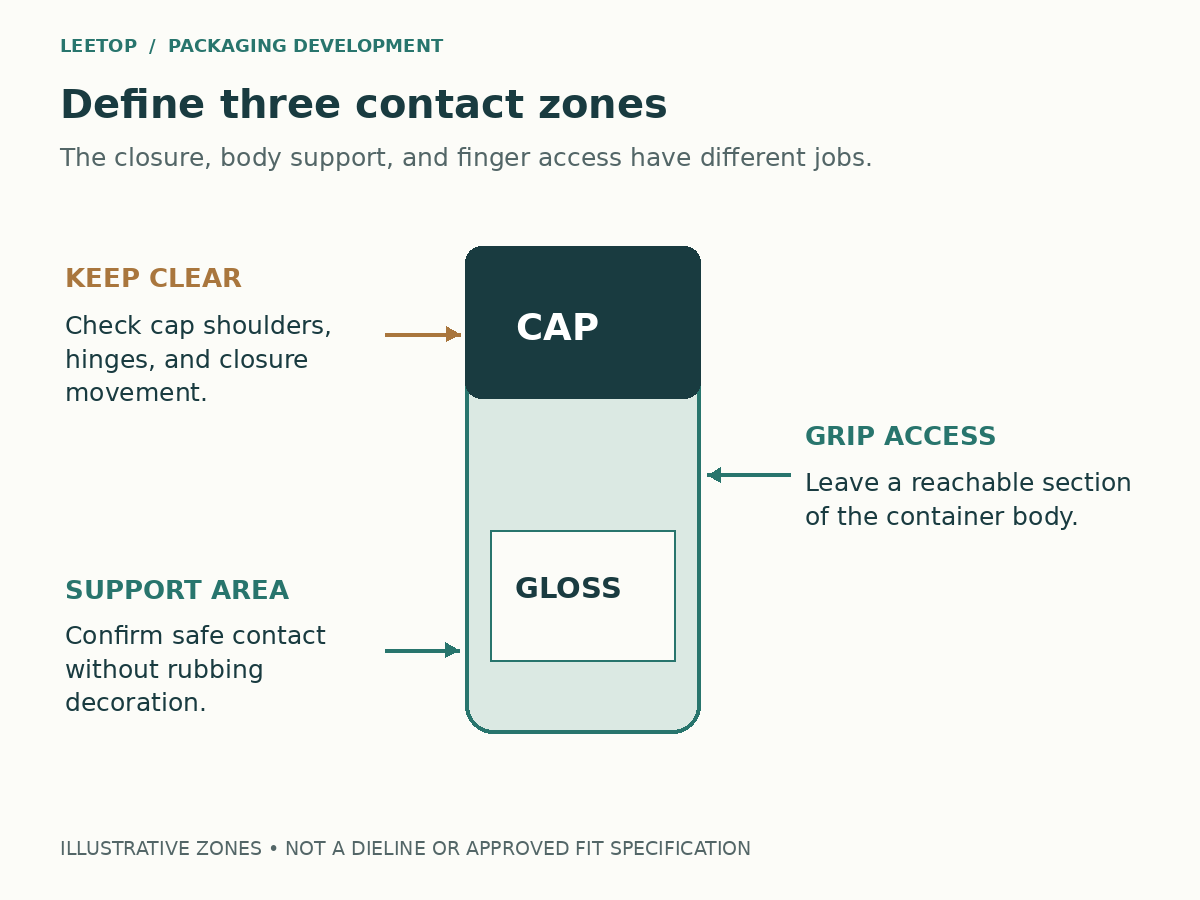
Define three surfaces on a reference photograph:
- Support area: where the carton or internal fold can contact the container without damaging decoration or operating the closure.
- Keep-clear area: where the cap, hinge, seam, or applicator assembly needs space.
- Grip area: where fingers can reach the product during removal.
These markings do more than a single overall measurement. They explain how the package should work. Do not assume that the cap is a safe lifting point simply because it is the first visible part.
Decide whether the product needs to stay facing forward
A round tube inside a rectangular carton can rotate. That may be acceptable in a fully printed, closed pack. It becomes more important when a window must show a particular logo, shade name, or decorative face.
Choose the presentation requirement before selecting the support:
A closed carton with no fixed viewing face
Start by evaluating a fitted folding carton without a separate insert. Check loading, end closure, product movement, and removal. Add support only when a specific movement or handling problem remains. The aim is an intentional fit, not a requirement that every lip gloss carton contain an extra component.
A window aligned with the tube label
Test a locating fold, collar, or insert that keeps the intended face at the window. A window cutout alone does not control rotation. Confirm that any support touches an appropriate area and does not scratch the label or squeeze a flexible tube.
Decide whether the opening needs a film patch. An open cutout and a covered window have different component, assembly, and material implications. Neither automatically establishes tamper evidence or a particular protection level.
A tube that is difficult to grasp
Consider a finger opening, a shorter support wall, or an accessible section of the container body. Evaluate the result with the carton fully assembled. A product can sit neatly in a photograph yet be awkward to remove when the customer cannot reach it.
For the available carton family, see custom folding cartons. Any internal feature should be developed with that carton, rather than sized independently and added at the end.
Compare cap-first and base-first packing
Packing direction can change where a flap catches, which part of a squeeze tube bends, and how easily an operator loads the carton. Specify the intended direction in the structural brief.
For a wand tube, trial insertion from the proposed packing end with the cap fully closed. Watch the cap shoulder and label edges as they pass the internal folds. For a squeeze tube, check both the closure and the sealed tail. Do not use force to compensate for a catching flap.
Also separate packing access from customer access. The factory may load from the bottom while the shopper opens the top. Those two actions need to work on the same approved sample.
Ask the packer to assemble and fill a short trial using the intended sequence. Record whether cartons need reshaping, whether operators have to align the tube by feel, and whether a support folds out of position. A design that works only when assembled very slowly may need adjustment before production.
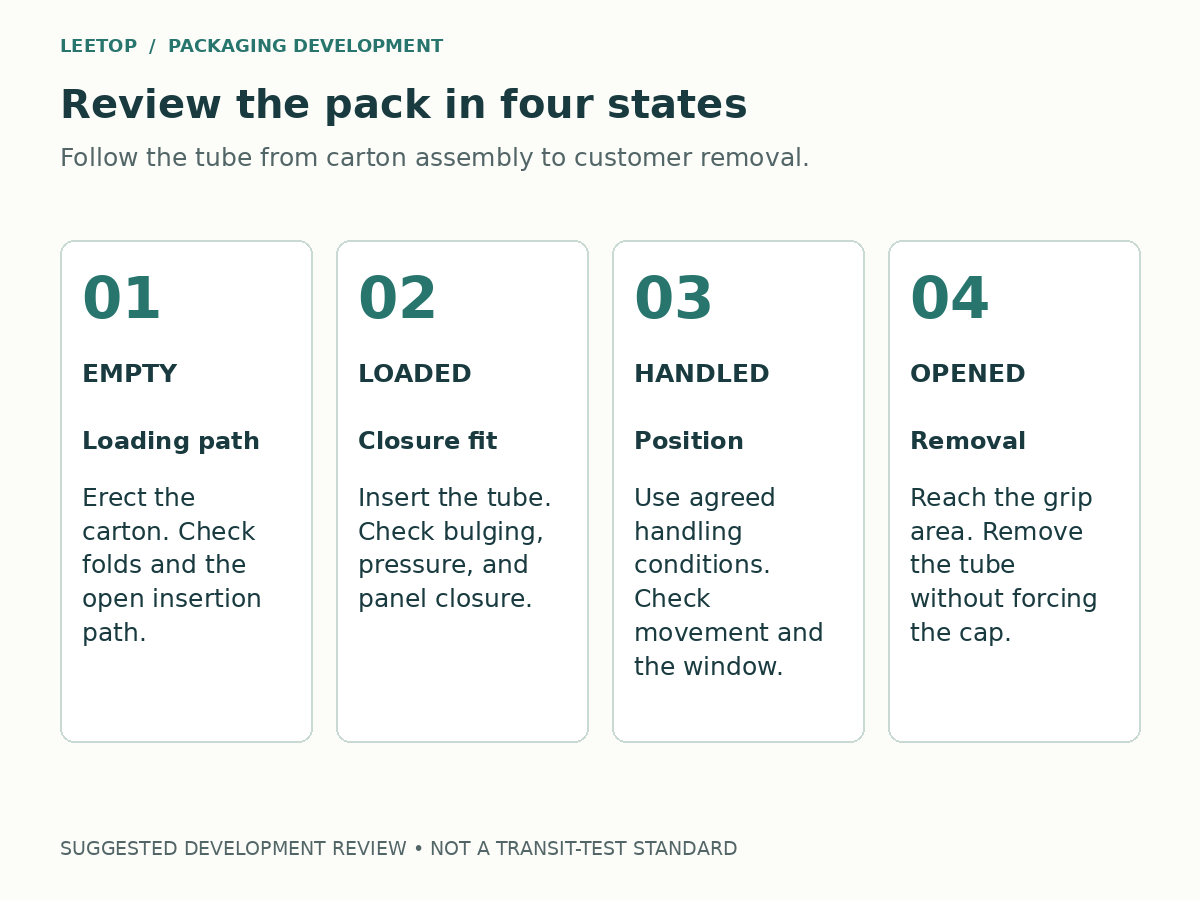
Run a four-state fit review
Use a simple review that follows the product from assembly to removal. This is a suggested development exercise, not a standardized transit test or a substitute for distribution testing.
Empty: erect the carton, engage the internal folds, and check that the intended loading path is open.
Loaded: insert the finished tube and close both ends. Look for bulging panels, a lifted flap, pressure on the closure, or a label that rubs during insertion.
Handled: use the closed pack in the orientations expected during packing and merchandising. Check whether the tube changes position and whether a window still shows the intended face. Any shake or tilt observation should be recorded as a development check, not a shipping-performance claim.
Opened: remove the product using the access the customer actually has. Check for a torn carton, a displaced support, an opened cap, or a tube that requires excessive pulling.
Keep the observations specific. “The tube rotates away from the window” is actionable. “It feels cheap” does not tell the developer whether to change the viewing requirement, support geometry, board, or finish.
If transit protection is a concern, evaluate the retail carton inside the intended distribution packaging. Passing a tabletop fit review does not prove that the complete shipment will survive its route.
Leave room for readable information
A narrow lip gloss carton has limited panel space. Set the structural features and usable panels before decorating the entire surface. Windows, glue areas, and tight folds reduce the areas where information can remain visible and readable.
The FDA Cosmetics Labeling Guide distinguishes information on outer and immediate containers. Have the responsible brand reviewer check the requirements for the actual product and sale format. This fit guide is not a complete labeling checklist.
For production-file preparation, use the existing cosmetic packaging artwork checklist. The structural approval and the approval of product copy are separate decisions.
Questions buyers ask about lip gloss cartons
Does every lip gloss box need an insert?
No. Evaluate the actual tube in a suitable carton first. An insert becomes useful when it solves a defined problem such as rotation at a window, excessive movement, or an inaccessible grip area. It should not obstruct loading or removal.
Can I use a lipstick carton for lip gloss?
Only after confirming the finished container profile, weight, packing direction, and opening behavior. A similar appearance or fill quantity does not establish a shared structural fit.
Should the carton hold the tube completely still?
The acceptance target depends on the pack. A display window may require controlled orientation, while a closed carton may tolerate some movement. Agree on observable conditions and assess them on physical samples instead of specifying an arbitrary universal clearance.
Will a smaller carton always be better?
No. Reducing empty space is useful only while preserving loading, closure clearance, readable panels, and product removal. The smallest possible rectangle is not necessarily the most usable carton.
Send the container and the intended interaction
To discuss a lip gloss carton with LEETOP, send finished tube photos or samples, dimensions, filled weight, the desired viewing face, and the packing direction. Mention any window or removal problem you want to solve. Add your quantity, artwork status, and delivery location to request a packaging review.