Foldable rigid boxes can reduce the space needed to ship and store empty packaging, but they are not automatically cheaper overall. Compare the delivered box-and-insert cost, local assembly labor, and warehouse handling for the same finished pack. Once the box is assembled and filled, its earlier flat-packed form does not by itself reduce the size of the customer shipment.
That distinction matters for beauty brands ordering presentation boxes from overseas. The useful question is whether moving part of the assembly work to your own team or fulfillment partner creates a lower total cost for your actual order.
What are foldable rigid boxes?
Foldable rigid boxes, also called collapsible rigid boxes, use a rigid-board construction with joints or panel arrangements that allow an empty box to arrive in a reduced-volume form. The box is erected before use. Depending on the design, assembly may involve adhesive areas, locking details, or other joining features.
A magnetic lid closure and the mechanism that holds the corners together perform different jobs. Ask for an assembly demonstration of the exact construction being quoted. A box that is shipped flat is not necessarily designed to be repeatedly collapsed after its adhesive joints have been fixed.
This is also a different product from a conventional folding carton made from creased paperboard. If you are still deciding which family of packaging you need, start with the rigid box versus folding carton comparison.
Where does shipping flat create a benefit?
The potential benefit applies to the movement and storage of empty packaging before filling. A smaller packed shipment may reduce chargeable volume, carton count, or warehouse space. The result depends on the complete packing arrangement and the transport service.
FedEx explains dimensional weight as a comparison between the space a parcel occupies and its actual weight, with charging based on the greater weight. That illustrates why compact packing can matter. It does not mean a parcel formula predicts an ocean-freight quote or that a reduction in cubic volume creates the same percentage reduction in your invoice.
Ask the supplier for packed carton dimensions, gross weight, carton count, and the number of complete packaging kits covered. Obtain freight quotes for the same origin, destination, service, and delivery scope. Include pallets where they apply.
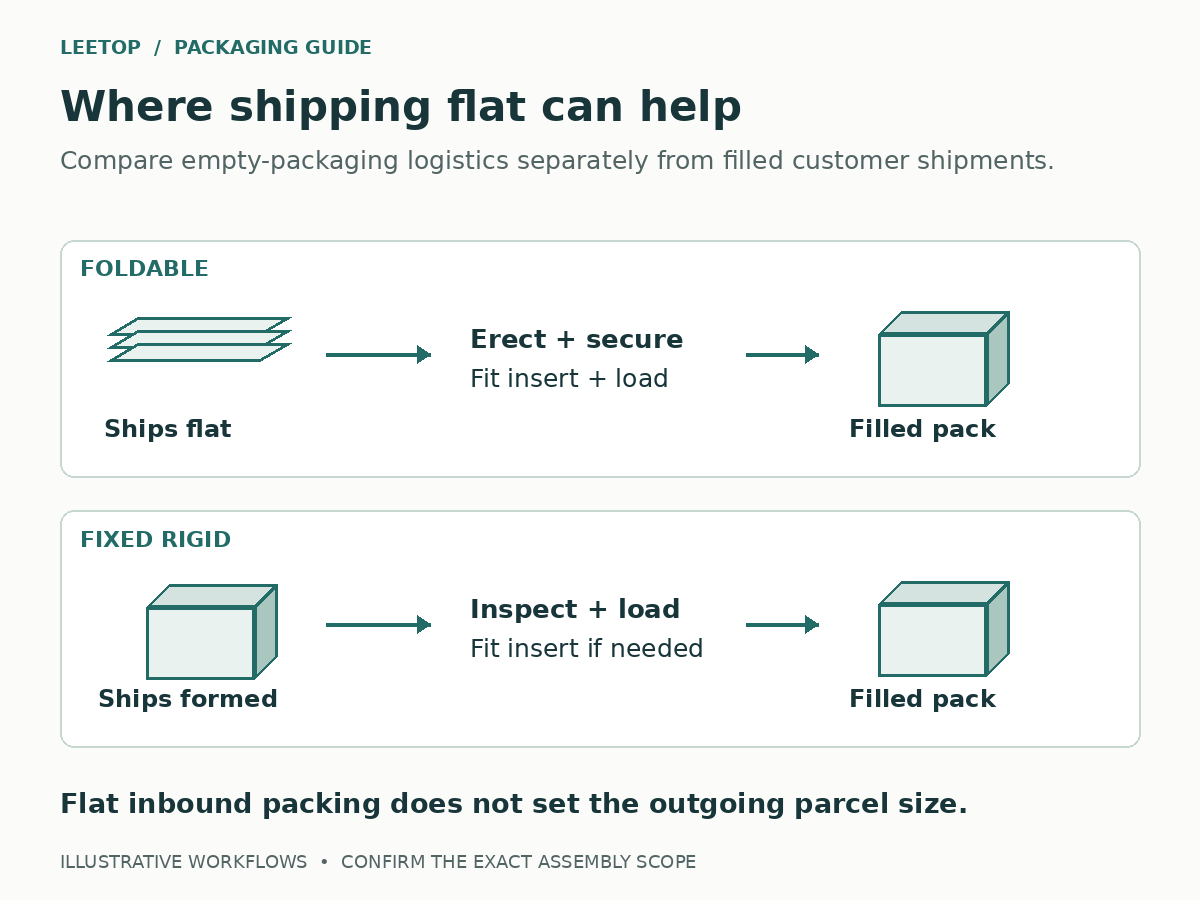
Compare three ways to receive the same packaging
Fixed rigid boxes supplied assembled
Receiving condition: The box shell arrives formed, with the insert fitted or packed separately as agreed.
Local work: Receive, inspect, load the product, and complete any remaining packaging steps.
Cost to confirm: Full export packing volume and storage needs, plus any insert-fitting work still required.
Foldable rigid boxes supplied flat
Receiving condition: Box panels arrive in their approved shipping configuration. Inserts and accessories may have separate cartons.
Local work: Erect and secure the box, inspect the result, install the insert, and load the product.
Cost to confirm: Complete shipment volume, additional box assembly, workbench capacity, and fulfillment charges.
Foldable rigid boxes supplied assembled
Receiving condition: The supplier or another packer has already erected the foldable structure.
Local work: Similar to receiving an assembled presentation box, subject to the agreed insert and packing scope.
Cost to confirm: Whether any flat-shipping advantage remains on the route you are paying for. The construction name alone establishes no freight saving.
The insert can change the calculation
A flat box shell is only one part of a packaging kit. If a deep formed insert occupies most of the shipment, reducing shell volume may produce a smaller overall benefit than expected. Include sleeves, cards, protective wrapping, and every insert carton when comparing packing lists.
Ask whether the proposed insert ships formed, nested, or flat, and what work is needed to install it. A flat paperboard insert may add erection steps; a formed insert may add shipping space. Either needs to be checked with the actual products. LEETOP's custom insert options provide starting points for that discussion.
Request packing data for the full order rather than multiplying the external size of one retail box by its quantity. Actual master-carton layouts, protective materials, and mixed components determine the shipment you receive.
Calculate savings after assembly labor
Use the same finished packaging specification and quantity for both options. One useful comparison is:
Net saving from the flat option = freight and storage savings − additional packaging cost − additional local labor − other additional charges.
Include only differences between the options. If inserting the product takes the same time in both workflows, do not charge that common work only to the flat option. Conversely, count extra inspection, liner removal, and rework when they are caused by the new assembly process.
Illustrative calculation, not a LEETOP quote or customer result: Assume an order for 500 box-and-insert kits with equivalent presentation and approved fit. Suppose the flat option saves $540 on inbound freight but adds $225 to the packaging purchase cost. Assume it needs 30 additional seconds per kit at a fully loaded labor rate of $24 per hour.
- Additional labor: 500 × 30 ÷ 3,600 × $24 = $100.
- Net saving: $540 − $225 − $100 = $215 for the order.
- Saving per complete kit: $215 ÷ 500 = $0.43.
The example assumes no difference in storage fees, tooling, taxes, duties, damage, or other handling charges. Add any actual difference before making the decision; these figures are arithmetic inputs, not market prices.
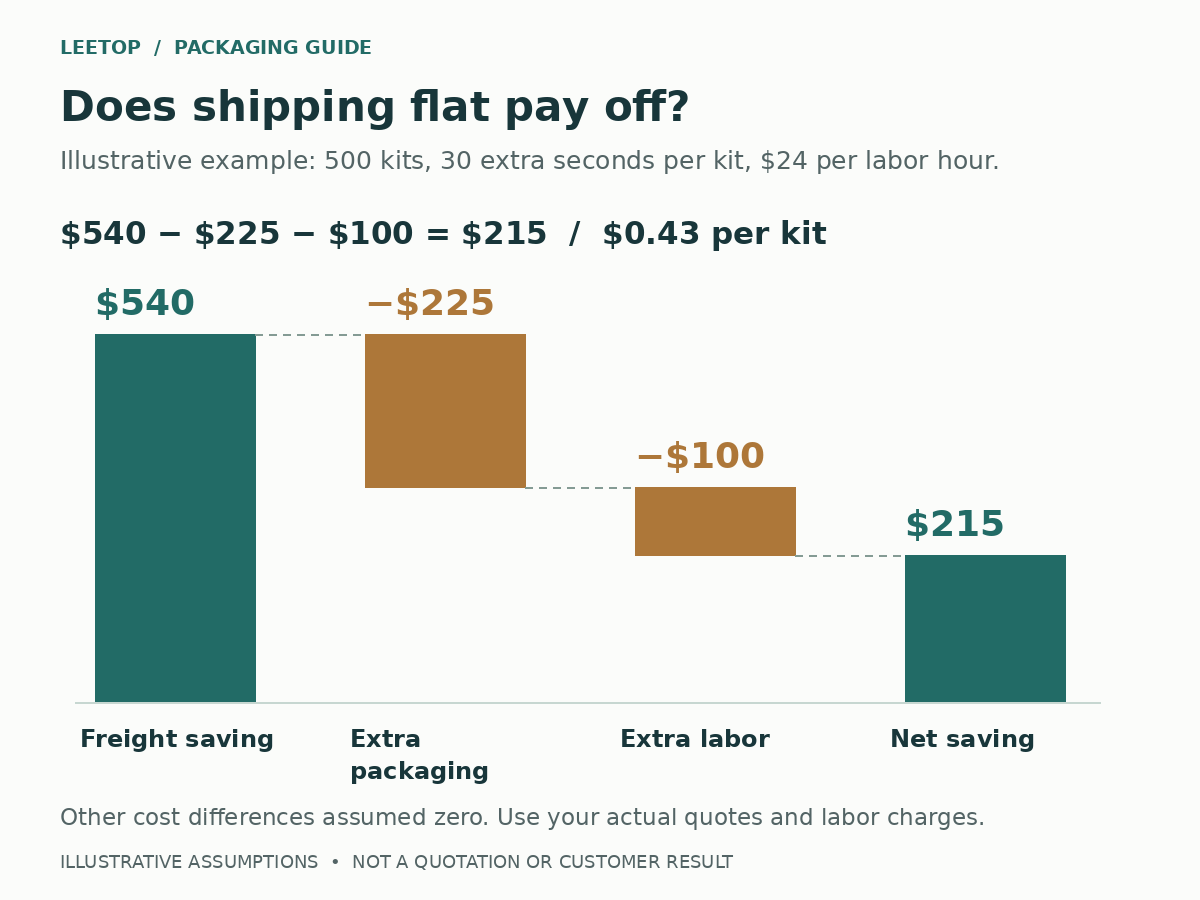
In that example, the freight saving leaves $315 available for extra labor after the packaging premium. At $24 per hour across 500 kits, assembly reaches break-even at 94.5 additional seconds per kit, assuming the other cost differences stay at zero. That is a limit calculated from the example, not an acceptable assembly time for every project.
Test the work your team will actually perform
Ask the person who will pack the order to assemble several production-equivalent samples. Time the full additional process: unpack the flat shell, remove liners if required, secure the corners, check alignment, and fit any components that add work compared with the alternative.
Record successful assemblies and defects separately. A fast demonstration by a supplier may not represent a new warehouse operator working through an entire batch. Ask a fulfillment partner whether it charges by time, completed kit, minimum batch fee, or another basis; use that charge in place of an assumed labor rate.
Review the loaded sample as well as the assembly sequence. Check that corners remain fixed, the insert stays positioned, the lid closes correctly, and repeated normal opening does not disturb the intended structure. Agree any distribution testing around the actual product and outer shipping pack. Foldability alone proves neither strength nor transit protection.
When is a foldable rigid box worth considering?
Consider it when you need a rigid presentation, empty-box shipping or storage is a meaningful cost, and the receiving team can assemble boxes reliably. It becomes a weaker option if packaging arrives already filled, local assembly is expensive, or bulky non-collapsible components dominate the shipment.
For a quote comparison, send the product dimensions and weight, intended insert, quantities, receiving location, and who will perform assembly. Ask LEETOP to compare a custom foldable rigid box with an assembled alternative using the same presentation brief and delivery scope.
Questions buyers ask about foldable rigid boxes
Are foldable rigid boxes cheaper than regular rigid boxes?
They can be cheaper on total delivered and assembled cost, but the box price alone cannot establish that. Compare complete packing data, freight, additional local work, and any fees that differ between the options.
Does shipping flat save the same amount on customer deliveries?
No automatic saving follows. Once filled, the presentation box needs an outer shipping solution appropriate to the product. Its dimensions and packing arrangement determine that outgoing shipment, regardless of how the empty shell originally arrived.
Can a foldable rigid box hold a perfume or skincare set?
It can be evaluated for that use with the actual products, filled weight, insert, and approved structure. Request a loaded sample; do not transfer a strength claim from a different box size or product.
What should I request before placing an order?
Request a functional sample, assembly instructions, complete packing list, and a quote that identifies delivery and assembly responsibilities. Send LEETOP your packaging requirements to compare the cost of receiving boxes flat with receiving them assembled.