Choose custom soap boxes after deciding whether the bar will be wrapped, exposed through a window, or fully enclosed. That decision changes the finished dimensions, the surfaces that touch the carton, and what shoppers can see. A paper box alone should not be treated as a verified moisture barrier.
For beauty brands, the useful starting point is a sale-ready bar and a written packing method. This guide explains how to compare the three presentation options, handle variation between bars, and approve a sample that represents the product you will actually ship.
Decide what sits between the soap and the paper
The packaging brief should identify every layer touching the bar. A separately wrapped bar inside a carton is a different package from a bare bar touching printed board. Even if both use the same outside artwork, they need separate fit and contact reviews.
Ask the soap producer to confirm when the product is ready for packing, its storage conditions, and the wrapping method already approved for that formula. The box supplier needs those decisions before developing the structure. Choosing a carton is not a substitute for confirming the soap's readiness or packaging compatibility.
Melt-and-pour soap deserves particular attention. Bramble Berry explains glycerin dew as moisture drawn from the air and recommends tightly wrapping bars as one preventive measure. That guidance supports discussing the inner wrap; it does not establish that every soap needs the same wrapping material or that ventilation is always beneficial.
If the brand wants direct contact with paper, record the exact board, ink, coating, adhesive, and contact surfaces for review. A supplier's description of a board as kraft, premium, or natural does not answer whether that finished construction is suitable for the specific bar.
Compare three retail presentation options
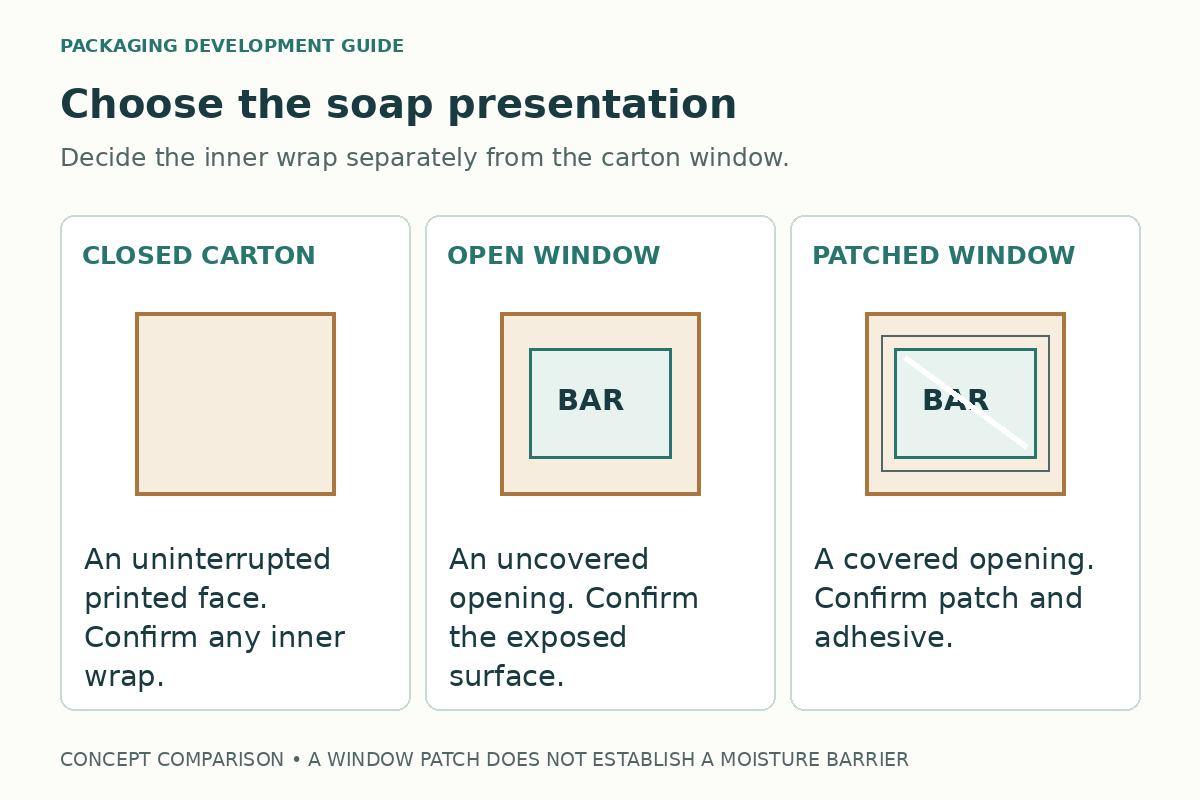
A fully enclosed carton
Useful when: The brand wants an uninterrupted printed surface and does not need shoppers to see the bar before purchase.
Confirm: Whether an inner wrap is still required, which face carries the product identity, and how the buyer opens the carton without damaging the bar. Closed flaps do not make a conventional folding carton airtight.
An open window
Useful when: Showing the actual bar is a deliberate part of the retail presentation and exposure through the opening is acceptable for the approved product and sales channel.
Confirm: Which product surface remains exposed, whether an existing inner wrap is visible through the opening, and how the cutout behaves when the pack is handled. A window should frame the bar without leaving fragile paper edges or letting the bar push through.
A window with a transparent patch
Useful when: The brand wants visibility while covering the opening.
Confirm: The patch material, adhesive area, clarity, and relationship to the inner wrap. A patched window is not automatically a sealed moisture-control system. Review the actual construction before making a protection claim.
Measure the bar at the stage when it will be packed
Measure finished examples from the intended packing stage. Include a decorative top, uneven edges, an applied label, and any wrap overlap. Keep bare-bar measurements separate from wrapped-bar measurements so the supplier can see what changed.
For handmade products, one attractive sample may not represent the full size range. Ask the producer for representative examples and agreed production tolerances. Record the largest dimensions that need to fit, the smallest examples that must remain acceptably positioned, and the acceptable variation in appearance behind a window.
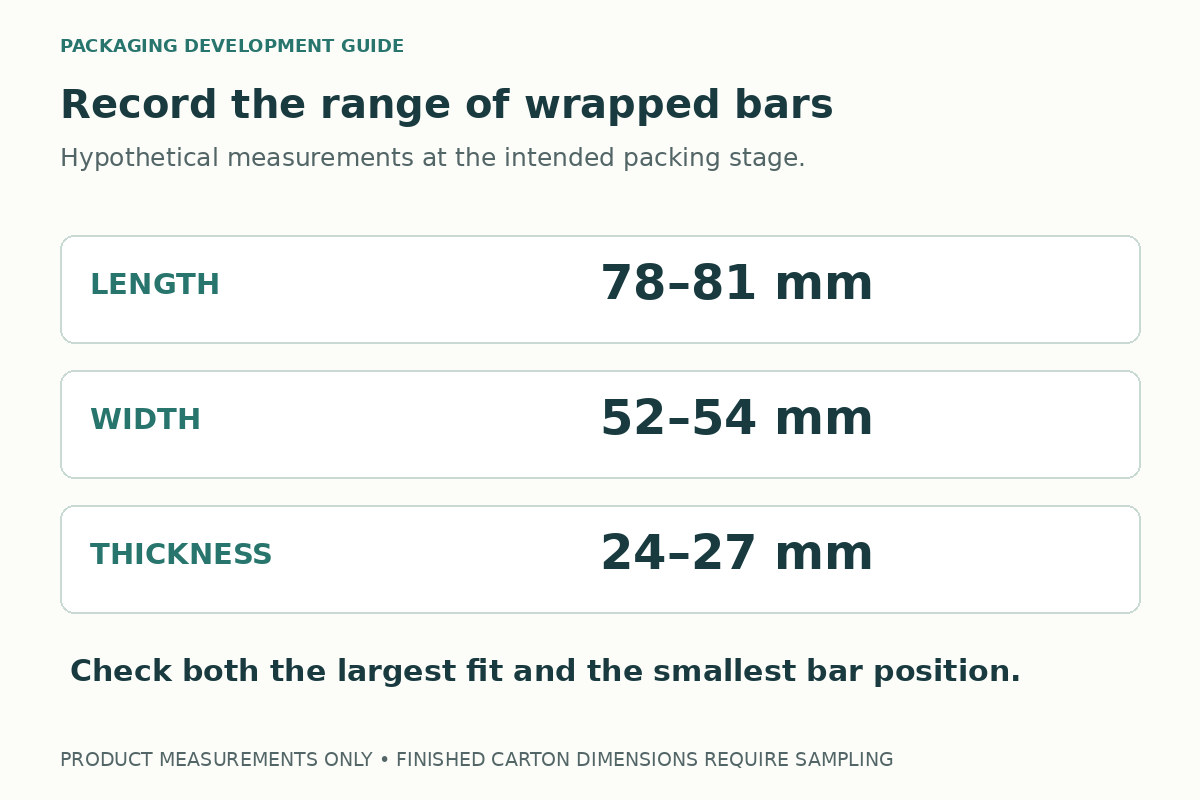
Illustrative example: A brand records wrapped bars ranging from 78 to 81 mm long, 52 to 54 mm wide, and 24 to 27 mm thick. Those figures describe product variation only. They do not establish the carton dimensions or the required clearance.
A carton developed around the 78 × 52 × 24 mm example may fail to accept a larger bar. A carton that accepts the largest example may leave a smaller bar off-center. The development task is to agree on acceptable fit across the range, then verify it in samples. Do not simply add a universal allowance to all three dimensions.
Check appearance after the pack has been assembled
Use the actual bar and wrapping method in a finished sample. Agree with the product producer on the storage and handling conditions that matter, then inspect the pack at the agreed intervals. An empty paper sample cannot establish how the filled package will look over time.
Look for visible marks inside and outside the carton, changes to the wrap, clouding at the window, an uneven window patch, rubbed decoration, and a bar that shifts away from its intended position. Record the conditions and observations rather than declaring an arbitrary storage period a pass for every product.
When a mark appears, identify its source before changing the entire box. The cause may involve the product, the wrap, the contact surface, or handling. Changing paper color can conceal a mark while leaving the underlying compatibility question unresolved.
Make one carton work across scents only when the products fit
A shared carton can be practical when scents use the same approved bar geometry, wrapping method, and packing sequence. Confirm those facts before ordering one common structure with several artwork versions.
Keep the scent identification readable after stocking. If cartons stand upright, a mark on the hidden bottom panel may be inconvenient. If they lie flat in a tray, a front-panel design may be partly obscured. Review the actual retail orientation rather than only the flat artwork.
For a range with materially different bar shapes, ask whether separate structures or a deliberately revised common size provide the better fit. The LEETOP folding carton page shows the development route for custom paper boxes; the final specification should reflect the actual products.
Questions about soap carton orders
Can a box with a window also contain a wrapped bar
Yes. Check how the wrap seam and any wrinkles look through the opening. Positioning the window and positioning the wrapped bar must be reviewed together.
Does kraft board make a soap box moisture resistant
The name alone does not establish barrier performance. Ask for the exact construction and evaluate it with the approved soap and wrap under the intended conditions.
Can the box dimensions come from the soap weight
Weight does not describe the bar's shape, decorative top, or wrapping overlap. Send physical dimensions and representative samples as well as weight.
Prepare the soap box brief
Send LEETOP the bar dimensions at the packing stage, the observed size range, photos of the wrapped or unwrapped product, and the preferred window treatment. Add quantities by scent, artwork status, retail orientation, and the delivery destination. LEETOP can review the paper packaging structure and coordinate sample development around that information.
Use the packaging quote request to identify which decisions are already approved and which still need review. The most useful first sample reproduces the intended packing method with the real bar.