Recheck custom serum boxes whenever the bottle, pump, dropper, overcap, or label construction changes. A replacement container can keep the same advertised capacity while changing the dimensions and contact points that determine carton fit. Approve the complete new container inside the packaging before treating an old box specification as suitable for a reorder.
This guide is for skincare brands managing a new serum pack or a change to an existing one. It focuses on the handoff between the container supplier, filling team, and paper packaging supplier, so each party works from the same physical version.
Define the container in its packed condition
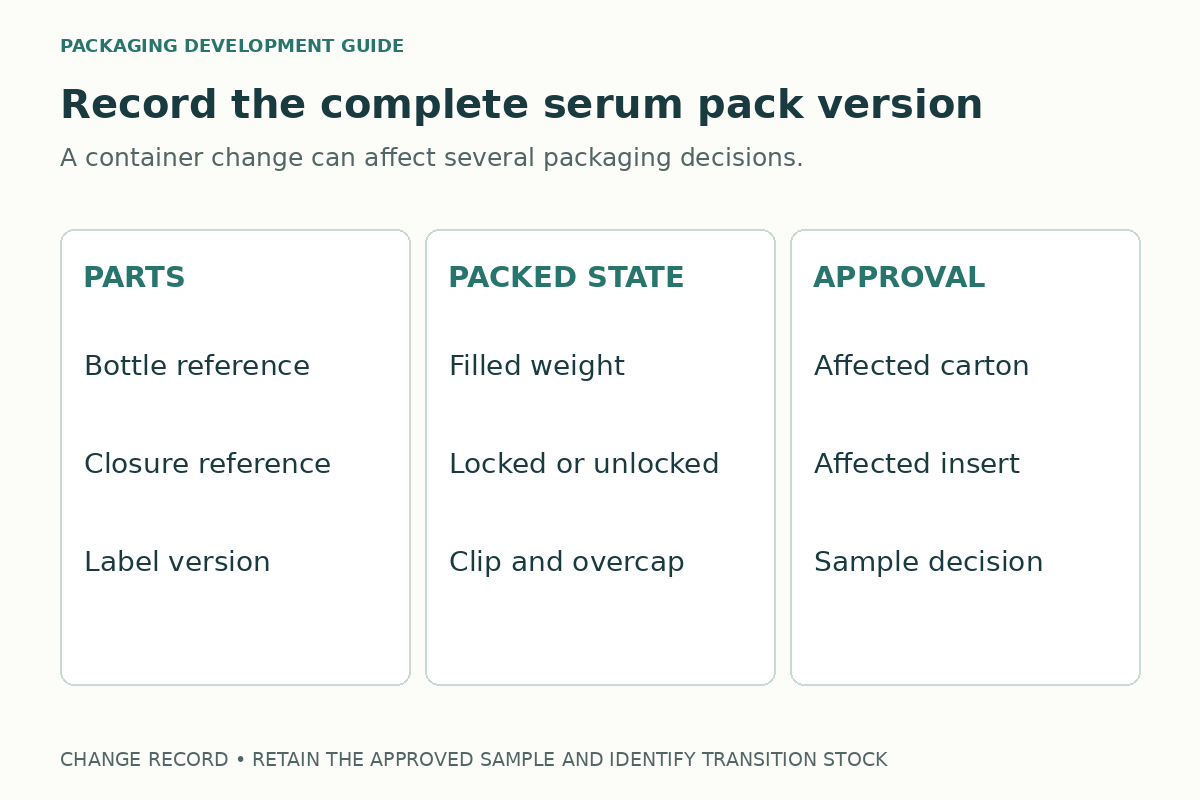
The packaging reference should show the filled, closed container exactly as it enters the carton. Include the fitted label, collar, dropper bulb, pump clip, overcap, and any seal that will be present. State whether a pump is locked or unlocked during packing.
Photographs are helpful, but they should accompany a dimensioned drawing or physical sample. A front image can conceal a projecting pump nozzle. A bottle drawing may omit the overcap. A label thickness change may be difficult to see yet matter at a close-fitting support.
Give the complete assembly a revision identifier. If the bottle and closure come from different suppliers, record both part references. The box supplier should not have to infer which cap in an email thread belongs to the latest sample.
Identify which changes require a new fit review
A taller closure or overcap
Recheck the space above the container, the closing motion, and any top support. A lid that looks closed in a photograph may still press on a flexible dropper bulb or an actuator.
A wider shoulder or label area
Recheck the loading path and contact with the insert or carton. A bottle may fit once positioned but scrape its label during insertion. Include the decorated container when checking that movement.
A heavier filled product
Recheck the base, support points, and intended handling conditions. Keep the empty-container weight and the filled weight separate in the record. A previous approval with an empty display bottle does not establish performance with the filled product.
A different pump locking method
Confirm the intended packed state with the container supplier and filling team. Record whether a separate clip or overcap is required and who installs it. Review how those components affect both the dimensions and the packing sequence.
Separate the support surfaces from the dispenser
Ask the packaging developer to mark where the container is intended to rest and which surfaces should remain free of unintended pressure. Review those choices with the primary-container supplier when they involve the neck, closure, or dispenser.
The insert should perform its intended holding function without relying on an unapproved load through a pump or dropper. Check whether the bottle can move far enough to contact the lid or an adjacent product under the agreed handling conditions. Also check whether the customer can remove it by gripping a suitable area.
For the paper packaging, LEETOP's custom insert development can be reviewed together with the carton. Material names alone do not establish the support geometry or the suitability of a contact point. Keep the drawing and the loaded sample together in the approval record.
Use a height comparison to expose a hidden change
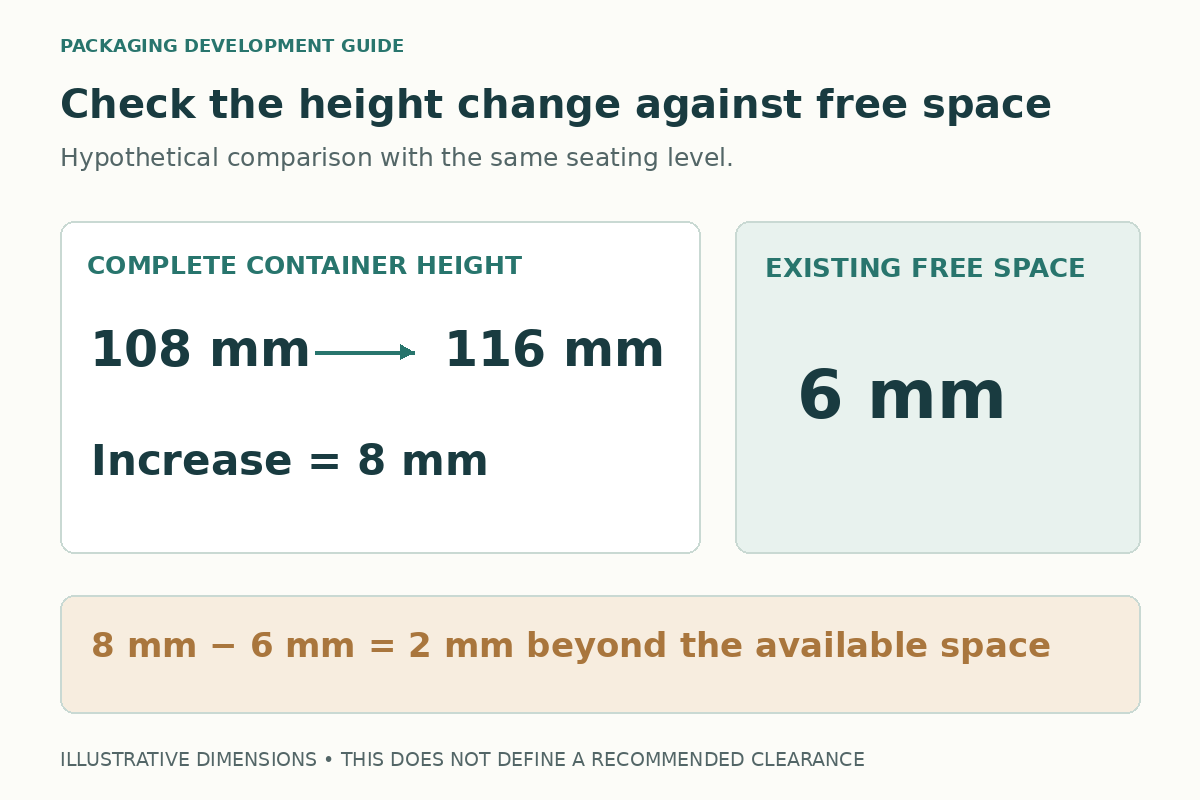
Illustrative example: An approved container assembly is 108 mm tall. A replacement pump assembly makes the complete packed container 116 mm tall. Assume its seating level is unchanged and the old pack has 6 mm of measured free space above the original assembly.
The new container is 8 mm taller. Under those assumptions, it exceeds the old free space by 2 mm. The existing pack therefore cannot preserve its approved closed geometry and clearance. Compressing the top or forcing the flap closed is not an acceptable substitute for reviewing the change.
The dimensions are hypothetical and do not define a recommended clearance. The practical response is to inspect the actual assembly, verify the seating level, and decide whether the closure, support, or box dimensions need revision. If the seating changes too, repeat the comparison from the new reference surface.
Keep fit approval separate from leakage and transport evaluation
A carton sample can answer questions about loading, closure, support, and removal. It does not by itself validate the container seal or the product's stability. Ask the responsible product and container teams to identify the evaluations required for the filled system.
For shipping, include the retail carton inside the complete proposed parcel pack. FedEx's guidance addresses protective outer packaging and cushioning; it does not certify an individual serum carton. Agree on relevant distribution checks for the actual product and route.
Record which samples were evaluated, their component revisions, the conditions, and any changes afterward. If a dispenser is replaced after the check, determine what needs repeating. Avoid attaching an old test result to a newly changed package without reviewing the difference.
Release the reorder with a short change record
Before reordering, ask whether any component differs from the retained approved sample. If the answer is yes, record the old version, new version, reason for change, affected packaging, and approval status. Include a comparison photo where it makes the difference easier to see.
Separate remaining old stock from the new specification. If both bottle versions will be filled during the transition, identify which carton and insert each may use. Tell the packing team when the change takes effect and what to do with mixed deliveries.
The existing cosmetic artwork checklist covers file preparation and artwork control. Apply that process to any printed changes after the physical package is settled, so a label revision and a structure revision do not become confused.
Questions about serum packaging changes
Can two 30 mL bottles share one carton
Only if their complete assemblies fit the approved package under the intended conditions. Capacity alone does not describe height, width, closure projection, or filled weight.
Is a taller carton enough when the pump changes
It may address height, but also review the nozzle, locking method, support points, loading path, and removal. The changed pump can affect several interactions.
Can a digital render approve the fit
A render communicates a proposed arrangement. Use the actual container and a physical packaging sample to confirm the interactions that cannot be established from the image.
Send the old and new assemblies together
For a serum packaging review, send LEETOP the approved pack reference, the proposed container assembly, a list of changed parts, filled weights, quantities, and destination. If this is a new launch, mark the parts that are still provisional. That gives the development team a concrete basis for deciding which samples and drawings need to change.