For cosmetic gift boxes, approve the product assortment before approving the outer box. A set is ready only when its products, insert, printed information, and packaging quantities match. One missing jar or the wrong insert can leave an otherwise complete box unusable.
This guide helps beauty brands plan packaging for retail skincare and makeup sets. It explains when different assortments can share an outer box, how to count the components, and how to handle a product shortage or substitution without disrupting the approved pack.
Start with a separate component list for each set
Give each assortment its own set code and list every item inside it. Include product size, container version, quantity per set, individual retail carton if used, accessories, and printed instructions. Identify the outer box and insert revisions on the same record.
Decide whether products enter the gift box in their individual cartons or as finished containers. That choice changes the layout and the information visible to the buyer. It can also change the packing sequence: a carton that is easy to load by itself may be difficult to position inside a tight gift insert.
Keep product content decisions with the brand team. The packaging specification should reproduce the approved assortment, including the current product names and instructions. Treat the product list as controlled information rather than a decorative paragraph written at the end.
Share the outer box only after checking both layouts
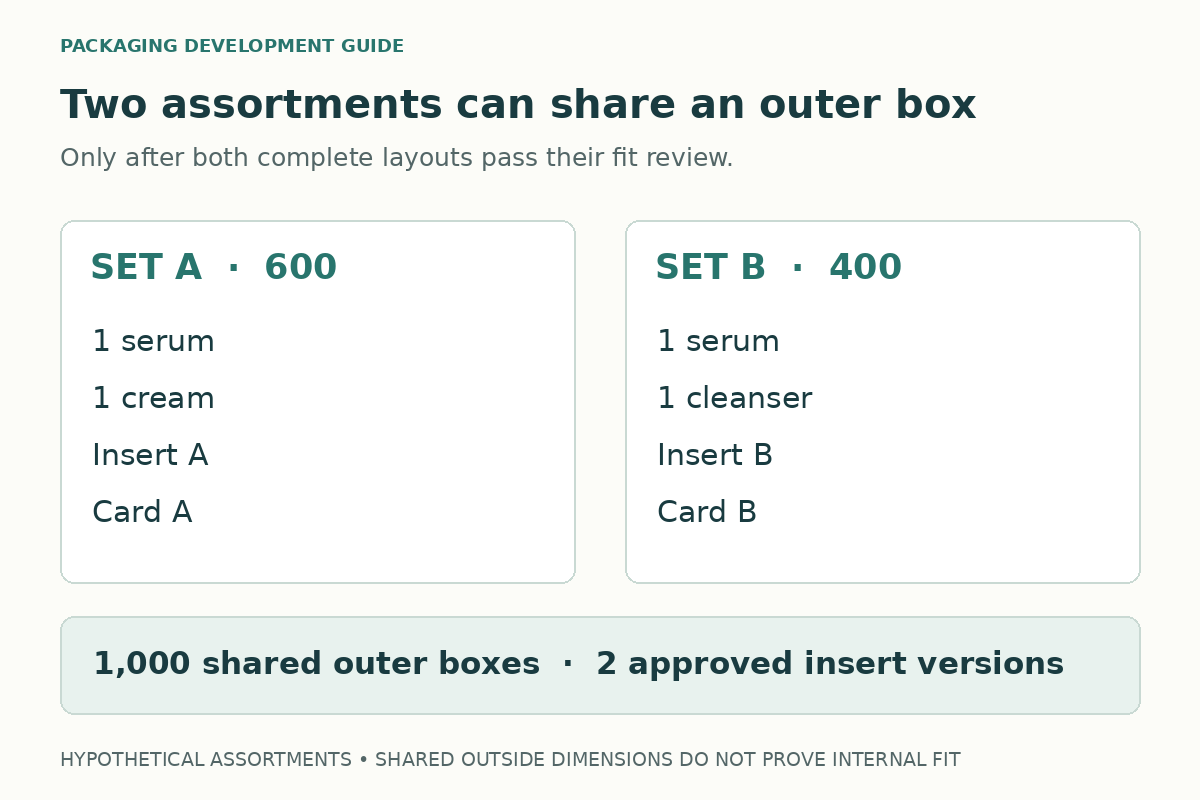
A common outer box may support two assortments if each has a suitable insert and the fully loaded packages meet the same closure and handling requirements. The relevant comparison includes height, weight distribution, removal access, and the available space for printed information.
Do not assume that replacing a jar with a tube preserves the fit because both occupy a similar area in a top view. The tube cap may require a different contact point. A tall bottle may change the closed height. A short item may sit too deeply to grasp.
Develop each insert around its own contents, then compare both loaded versions inside the proposed common box. Keep insert identifiers visible to the packing team before products cover them. A shared outside appearance makes that internal identification more useful.
Count the products from the assortment quantities
Use the quantity of each set to calculate its components. Avoid multiplying every product by the total number of boxes unless that product appears in every assortment.
Illustrative example: A brand plans 600 units of Set A, containing one serum and one cream, plus 400 units of Set B, containing one serum and one cleanser. Assume one outer box and one insert per set, with no extras or losses included in this first calculation.
The base requirement is:
- 1,000 outer boxes for 600 Set A units and 400 Set B units.
- 600 Set A inserts and 400 Set B inserts.
- 1,000 serums, because both assortments contain one.
- 600 creams for Set A and 400 cleansers for Set B.
- 600 Set A information cards and 400 Set B information cards, if each set uses a version-specific card.
This produces 1,000 complete sets containing 2,000 product units. It does not include additional products for photography, sampling, damaged units, or other reserves. Add those requirements as named lines so the team can see why they exist.
Track complete sets as well as individual inventory
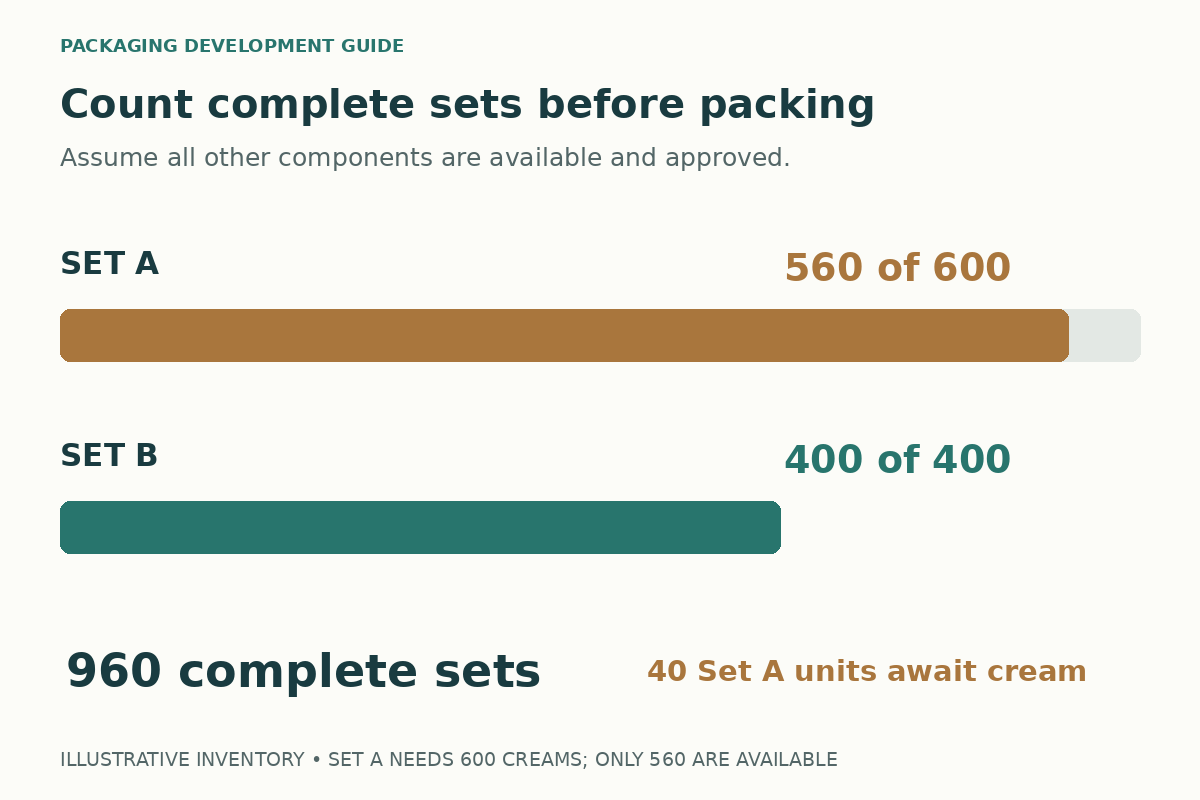
Ordering 1,000 boxes does not establish that 1,000 sets can be assembled. Compare available, approved components against the requirement for each assortment.
In the same hypothetical example, suppose only 560 creams are available while all other base quantities have arrived and passed the agreed checks. The team can complete 560 Set A units and 400 Set B units, or 960 sets total. Forty Set A boxes remain incomplete until the cream shortage is resolved.
That calculation assumes no components are reserved elsewhere and no other constraints apply. Its purpose is to make the shortage visible before the packing team starts, not to predict a supplier's production yield.
Give substitutions a clear approval route
A substitute product can change more than the product list. Check its container geometry, filled weight, decoration, closure, and instructions. Compare it against the approved insert and printed set description before releasing it to packing.
If the change affects the cavity, request a revised insert sample. If the product fits but the printed card names the old item, revise the card. If the outside of the gift box lists the contents, that artwork may also need a change. Document which components are still valid and which must be separated from the new version.
Agree on who can authorize substitutions. The packing team should have an approved version to follow, with a photograph showing the correct contents and orientation. An informal instruction to use whatever is available creates a different product from the one the customer ordered.
Decide how and where the sets will be assembled
Specify whether the packaging arrives flat, partly assembled, or ready for product loading. Identify who installs the insert, adds the products, checks the assortment, adds any information card, and closes the box.
Run a packing trial with the intended components. Record whether identification remains visible at each stage and whether an item can be loaded into the wrong position. If two inserts look similar, their labels or receiving cartons should make the difference clear before assembly begins.
For ecommerce, include the shipping package in the plan. FedEx advises placing chipboard gift boxes in a corrugated outer box. Confirm the protection required for the actual contents and distribution route; the retail gift box is only one component of that shipment.
Questions about skincare and makeup gift sets
Can the same gift box be reused for a seasonal assortment
Possibly. Check the complete new assortment, the insert, and every printed reference to the contents. A common outer size alone is insufficient to approve the revised set.
Should spare boxes equal spare products
List reserves by purpose and component. An empty replacement box does not require a second set of products if the original products will be transferred into it. A complete spare set does.
Does one box size mean one insert design
No. Two assortments may share an outer box while using different insert layouts. Each loaded version needs its own approval record.
Develop the gift set as one coordinated package
LEETOP's cosmetic packaging range includes skincare and makeup sets, with custom inserts developed around the contents. Send an assortment list, quantities by set, product dimensions, packing location, and destination through the packaging quote request.
If products are still being finalized, identify them clearly. That lets the packaging discussion distinguish a provisional layout from a version ready for physical sampling and production approval.