On a first small order of custom beauty boxes, the finish that looks best in a render is rarely the one that makes financial sense. Most premium finishes have two cost parts: a one-time making charge for the die or plate, and a per-unit application cost. When you are ordering 100 to 500 boxes, that one-time charge can dominate the math — which means the "same" foil logo can feel affordable at 1,000 units and awkward at 150.
The practical rule is to pick one signature finish that does a specific job — catching light on shelf, adding a tactile moment, or creating contrast in product photos — and let the rest of the box stay quiet. This guide explains how the costs break down, which finishes suit a first order, and how to describe them so every supplier quotes the same thing.
This is a procurement decision guide, not a price list. LEETOP confirms available finishes per project; the numbers below are illustrative assumptions to show how the math works, not quotes.
Finish cost is tooling plus per-unit application
Do not read a quoted "cost per box" for a finish as if it is the whole story. Two cost lines matter.
One-time tooling or making charge. Foil stamping needs a metal die cut to your logo or design. Embossing needs a matched pair of dies that press the board between them. Plates, blocks, or screens for other setups work the same way: you pay once to make the tool, before a single box is produced. This charge is independent of quantity.
Per-unit application cost. Once the die exists, each box carries a small unit cost for running the finish. This number usually falls as volume rises because the setup time and make-ready are spread over more pieces.
The reason this matters on a first order is simple: a low per-unit finish can become expensive when the tooling is divided over 100 boxes instead of 3,000.
An illustrative amortization example
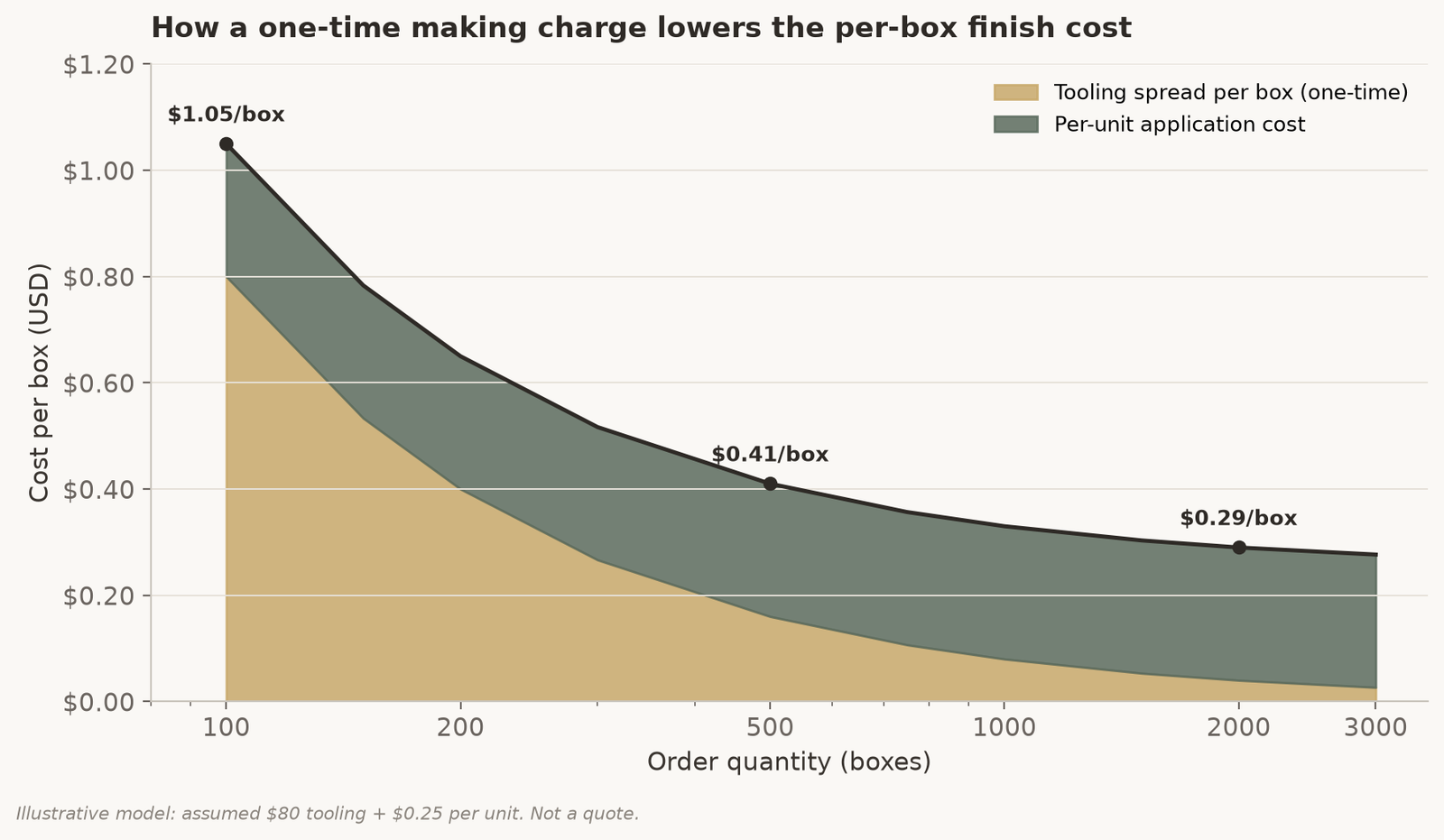
Assume a finish carries a US$80 one-time making charge and a US$0.25 per-unit application cost. These are round planning assumptions for teaching the math, not LEETOP pricing.
- At 100 boxes, the tooling alone adds US$0.80 per box (US$80 ÷ 100), so the finish really costs about US$1.05 per box.
- At 500 boxes, the tooling adds US$0.16 per box, so the finish costs about US$0.41 per box.
- At 2,000 boxes, the tooling adds US$0.04 per box, so the finish costs about US$0.29 per box.
The per-unit line barely moved. The tooling line dropped by more than 90%. This is why a finish that feels routine on a reorder can feel disproportionate on a first run, and why asking a supplier to separate "tooling" from "per box" in the quote is the single most useful question you can ask.
Third-party industry write-ups commonly put per-unit finish additions in broad ranges — for example, roughly US$0.10–$0.60 per unit for foil, US$0.10–$0.40 for embossing, and US$0.08–$0.20 for soft-touch lamination, before tooling. Those ranges are useful for orientation but depend heavily on box size, coverage, paper, and region; treat them as a starting frame, not as a price you should hold any supplier to. A published cost overview from Logic Pac is one such reference.
What each finish actually does
You do not need to choose a process name first. Choose the sensory moment you want, then match the finish.
Foil stamping — catches light at a distance
Foil stamping uses heat and pressure to transfer a thin metallic or pigmented film onto the box. It is instantly visible under store lighting, in flat-lay product photos, and across a room. Gold, silver, rose gold, and matte foils are common; holographic and colored foils are available for specific campaigns.
Foil works best as a small, deliberate hit: a logo, a product name, a thin rule, or an interior accent. Large foil coverage gets expensive and raises registration risk, and fine lines can fill in if the artwork is not prepared for foil. If your package mainly sells itself on a shelf or in imagery before the customer touches it, foil is the most direct visual signal.
Embossing and debossing — discovered by touch
Embossing raises an area above the surface; debossing presses it below. Both use a matched die set and are felt more than seen, especially when used as "blind" embossing without ink or foil. They reward close handling and pair naturally with uncoated or textured papers.
Embossing is quiet at a distance. A deeply raised logo may not register on a shelf, but it reads as quality the moment a customer picks the box up. It needs enough paper body to hold the impression, and tiny type or hairline rules usually do not emboss cleanly.
Spot UV — gloss against matte
Spot UV applies a glossy coating to selected areas, so the shine contrasts against a matte or uncoated surrounding surface. It is a light-catching detail without metallic foil, and it pairs well with tone-on-tone patterns, ingredient motifs, or a logo on a dark carton.
Its effect depends entirely on contrast. On a fully glossy box there is nothing to contrast against, so spot UV quietly disappears. On soft-touch matte it becomes a deliberate focal point.
Soft-touch lamination — the whole surface
Soft-touch wraps the entire box in a velvety matte film that changes hand feel the moment it is picked up. It is a common choice for premium skincare and fragrance because it signals calm, high-end feel across the whole package rather than on one element.
The trade-off is handling: soft-touch surfaces can scuff in transit and show fingerprints on dark colors if the outer shipper and packing are not planned with that in mind. It is usually a base, not a hero detail — one contrasting foil or gloss element on top of it does more than stacking several effects.
Start with the job, not the finish
Before naming a finish, decide where the sensory moment happens.
- Shelf and imagery first. If the box must read as premium in retail lighting or in a flat-lay photo, choose a visual finish: foil, gloss contrast, or a bold print. Touch happens later, from a distance.
- Unboxing and handheld first. If the product is sold online, arrives by mail, and is filmed by the customer, a tactile finish — blind emboss, soft-touch, interior print — earns more because that is when the box is actually held.
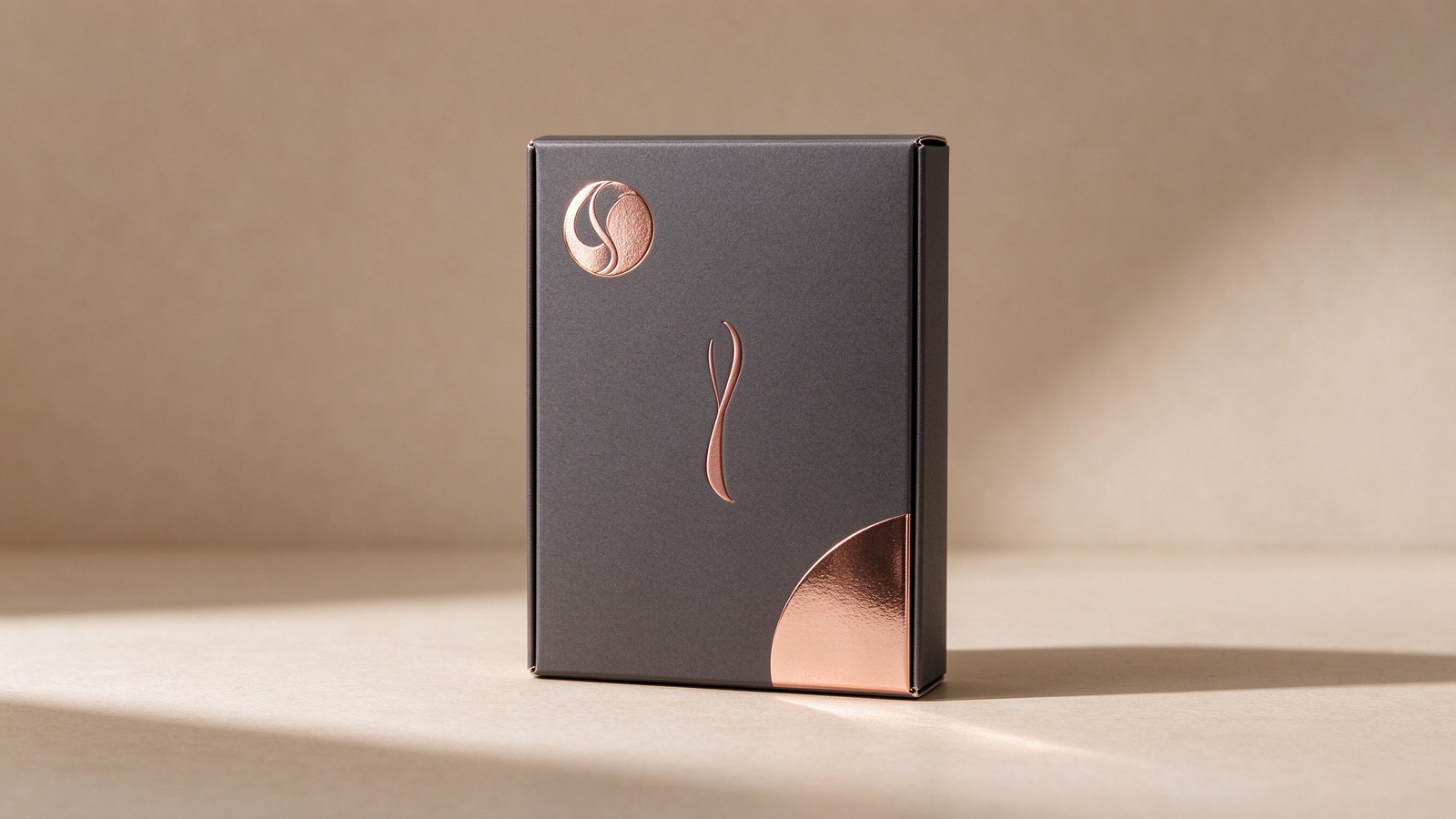
- One hero, one support. The most expensive-looking boxes usually use one signature finish plus one quiet contrast. A soft-touch carton with a small foil logo, or uncoated paper with a blind emboss, reads more controlled than a box running foil, emboss, spot UV, and specialty film at once.
A useful test: circle the one element you want a customer to notice first. If you cannot name it, adding more finishes will not solve that.
On a first small order, where the money goes
For a first production run in the low hundreds, tooling weight matters more than the per-unit range.
- Printed ink and paper color carry no separate die. Full-color offset printing on the carton itself is the baseline and usually the lowest-risk way to carry branding. LEETOP regularly produces custom printed folding cartons and rigid-box wraps.
- Foil on a small logo area is usually affordable even in modest quantities because the die is simple and the per-unit run is fast. It is often the best single premium signal for a first order.
- Blind embossing or debossing adds a matched die set and works best on sturdy paper; on very thin carton stock the impression can look weak. It is worth it when the logo will be handled, less so when the box is mainly seen on a shelf.
- Deep, multi-level, or combination foil-emboss work raises tooling and setup risk and is usually happier at larger quantities. It is a strong candidate for a reorder or a hero SKU rather than the very first run.
If your budget is tight on a first order, protect the box structure, paper, and print quality before adding finishes. A clean four-color print on a well-chosen paper, with one small foil logo, usually beats an ambitious finish stack on a box that will not close cleanly. The rigid box versus folding carton guide and the custom rigid box cost guide explain how structure and quantity move the baseline.
Describe the finish so suppliers quote the same thing
Vague words produce different quotes. "Premium feel" or "luxury finish" mean different things in different factories. Put the finish in production terms.
Send these details with your artwork:
- Box type and paper: folding carton or rigid box, approximate size, and paper or board grade if you have one.
- The exact element: logo, wordmark, border, pattern, or interior panel, and which panel it appears on.
- Foil: metallic color (gold, rose gold, matte gold, silver, other), solid coverage area, and whether it is on one panel or several.
- Emboss / deboss: raised or recessed, blind or combined with foil, and minimum line weight.
- Spot UV or coating: which artwork element gets the gloss, and what it contrasts against.
- Quantity and destination: number of boxes, likely reorder volume, and destination ZIP or postal code, so tooling and shipping are quoted separately.
- What you are not sure about: mark open choices as "please recommend" rather than guessing a finish the factory may not run cleanly.
Ask every supplier to split the reply into unit price, one-time tooling or making charges, sampling, and delivery, so a low per-unit number is not hiding a die charge another supplier folded in. The artwork prepress guide covers the file side; this finish brief covers the process side.
Approve the finish on a physical sample
Digital renders make every finish look perfect. The real questions — foil edge sharpness, emboss depth, coating feel, scuff resistance, and color under real light — only show up on a physical sample on your actual paper.
For brands that need design development, LEETOP offers a fixed design and sample package that includes a design proposal, vector production files, and one physical finished sample with delivery to your door, before any production order. That sample is the right place to approve the finish, the paper hand feel, and the logo registration together. The custom packaging sample process explains what a sample should resolve before you release production.
Reorder planning matters, too: if a finish's tooling makes sense at 500 units but you expect to sell through slowly, ask whether the die can be stored for a reorder rather than remade. On a confirmed repeat bulk order, LEETOP applies a reorder discount based on material and finishing complexity, which is where the per-unit math on those finishes finally improves.
Have a logo, a reference image, or a rough idea? Send LEETOP the box type, your product size, quantity, and destination ZIP — we will confirm which finishes suit the structure and separate the tooling cost from the per-unit price before you commit.