Yes. A supplier can use your AI-generated perfume box image as a design reference and develop a real paper box from it. You can start the conversation with the image, the finished bottle dimensions, your order quantity and the delivery destination. The image alone cannot determine how the box opens, whether the bottle fits, which surfaces print, or how the apparent metallic effects will be produced. Those decisions need a structural drawing, reviewed artwork and a physical sample before a production order is approved.
This guide is for a brand owner with a visual concept for a perfume box or gift set, not a finished packaging specification. If you already have a supplier's approved dieline and editable artwork, you can move straight to a production review.
What can the supplier learn from an AI mockup?
An image is useful for the overall shape, the intended unboxing, color direction, logo placement and the feeling you want to create. Mark the elements you care about most. Is the separate lift-off lid essential? Must the bottle stand upright? Should the logo appear only on the top, or continue across an edge? An image usually shows one angle; attach another view or annotate what should happen on the back and inside.
Separate must keep from open to change. For example, “keep the narrow lid-to-base reveal and the centered bottle” is clearer than “make it exactly like this image.” If the concept shows a lid floating above a box with no closing geometry, the manufacturer must propose a workable closure rather than copy the visual literally. LEETOP's fragrance packaging page accepts a sketch, reference photo or AI image as the starting point for developing structure, artwork and a fitted interior.
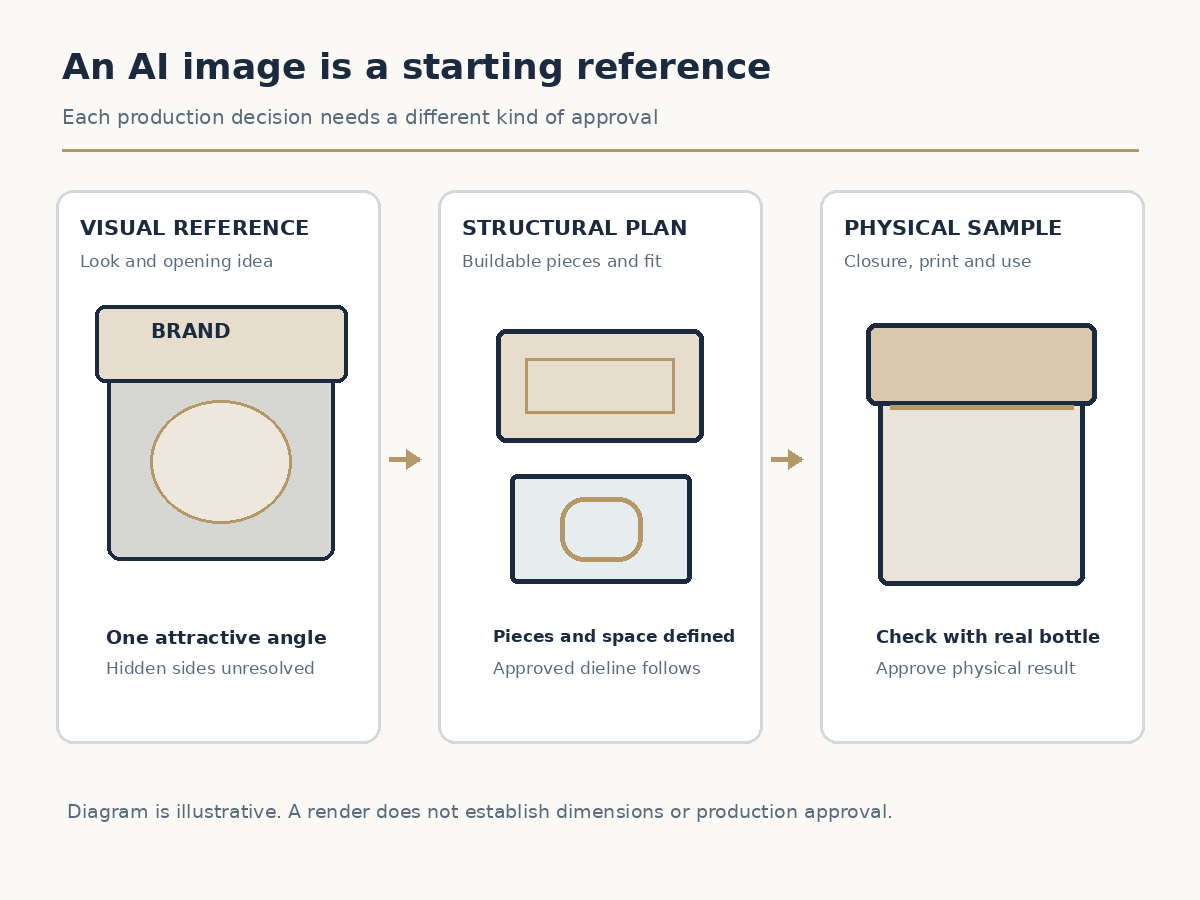
Why is the picture not a print-ready file?
A rendered box can hide the back, underside, folds and seams. It may show a color gradient crossing an edge that cannot be judged from one perspective. A shiny gold area might be proposed as foil, metallic paper, ink or another finish; each needs its own specification and approval. A generated logo or small type may be distorted. Treat all lettering in the image as a placeholder until the brand supplies or approves the actual words and logo.
A dieline is the flat structural layout for a chosen box: its cut, crease and other production features depend on the structure, dimensions and material. Packly's dieline explanation shows why the drawing changes with construction and board thickness. It is a useful general example for a folding carton, not a ready-made template for every perfume box.
The file extension can also be confusing. An AI-generated image may be a JPG, PNG or PDF containing a flat picture; an .ai file is commonly an editable Adobe Illustrator document. Renaming the image “design.ai” does not create editable text, logo paths, cut lines or printable panels. Adobe describes Image Trace as a way to convert raster imagery to editable vector graphics, but tracing still leaves the real text, logo, panel layout and structure to be checked.
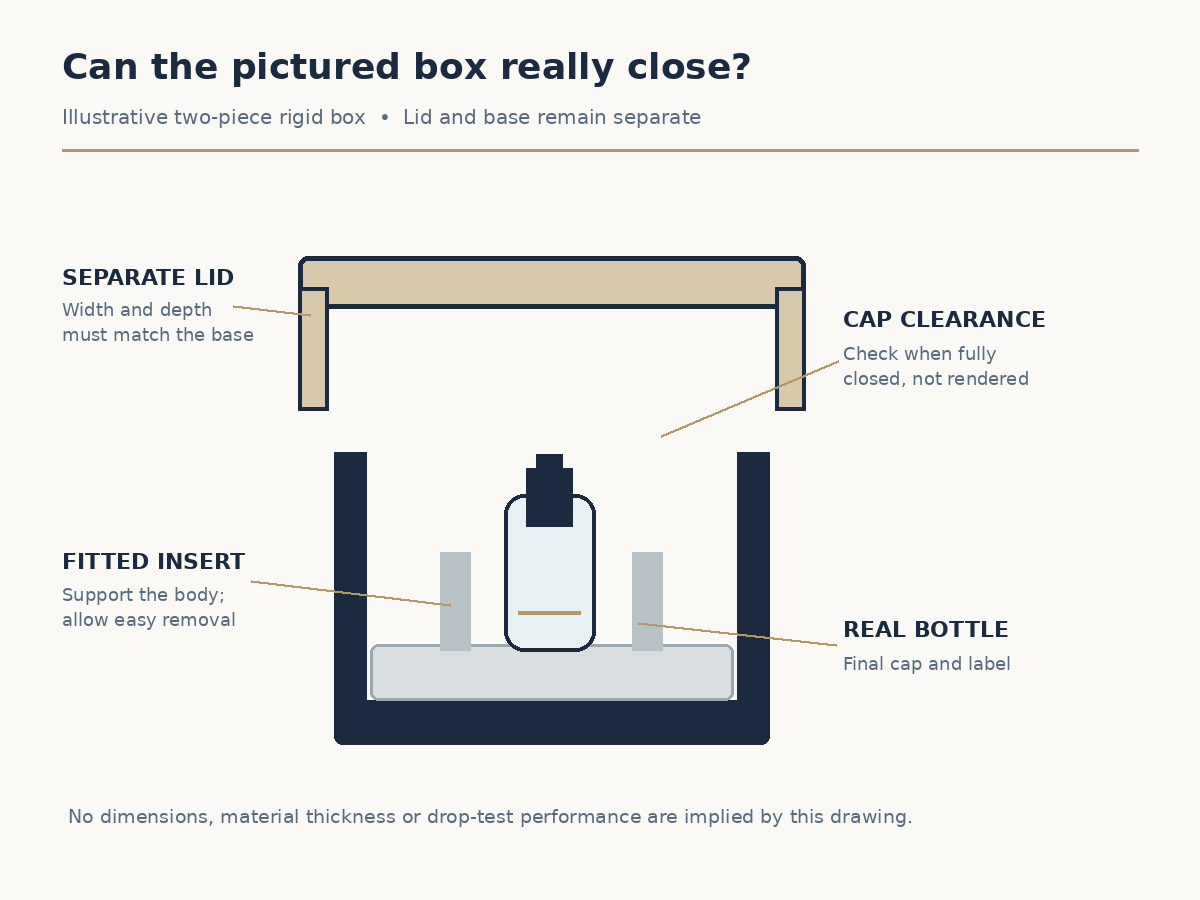
Which parts of the pictured box can actually close?
Ask the supplier to name the construction before approving artwork. A lid-and-base box has two separate pieces; a magnetic book-style box has a connected cover. A drawer has a moving tray inside a sleeve. A single image may make these look similar while hiding how the customer opens and closes the pack. LEETOP's box style overview shows the distinct opening types.
For a two-piece rigid box, ask for a closed and an open view of the same proposed structure: lid depth, base height, where the lid sits, and the usable space after the insert is installed. For a carton, ask where the tuck flaps and glue area go. If an image combines separate lid movement with a visible hinge, tell the supplier which behavior you actually want and let the structural drawing resolve the conflict.
The product inside determines the scale. Send the finished perfume bottle with its final cap and label, or record its maximum width, depth, overall height and filled weight. State whether the proposed insert must avoid a label or protect a fragile cap. A 50 mL label is a volume, not a bottle measurement; use the perfume box dimensions guide for the full measuring sequence.
What should I send if I have no dieline or vector logo?
Send what you have now and label what remains undecided. A useful first message includes:
- Visual reference: the AI image, plus arrows or notes identifying the shape, colors, visible faces and details that must stay.
- Actual product: bottle photos from the front and side, dimensions with units, final cap and label status, filled weight, and whether a physical bottle is available.
- Preferred opening: separate lid, hinged cover, drawer, folding carton, or “please propose the closest buildable option.”
- Printed content: your real brand name and product words, an original logo file if available, and the language or information you want on each face. Mark anything still awaiting review.
- Finish direction: the look you want from the image and which effects you want priced as actual print or finishing operations.
- Order scope: number of boxes per design, any insert or printed card, whether you need empty bottles or labels, destination ZIP or postal code, and desired delivery date.
You do not need to invent a finished external box size from the image. If the bottle is not final, say so: request a preliminary structure and quote range, then confirm dimensions after the bottle and insert are fixed. If you already have editable art, send that too; ask the supplier to check it against the approved dieline for the exact construction rather than a similar online template.
What needs approval before a production order?
Agree on three separate checkpoints. First, structure and fit: the supplier proposes the construction, insert, internal space and opening action. Review a structural sample with the actual finished bottle. Second, artwork and finish: map approved copy, logo, colors and finish areas onto the final dieline; check which face each element reaches and review an appropriate print or finish proof. Third, production reference: record the accepted sample, dimensions, board and insert specifications, artwork version, finish choices, quantity and delivery scope together. The sample process guide covers that broader approval sequence.
Hold the sample and close it with the product inside. Check that the lid sits correctly, the bottle does not force the box open, the label does not scrape, and you can remove the bottle naturally. Check the finished color and foil against the approved physical reference when those details matter. A screen render helps discuss appearance; it does not verify any of these physical results.
For an initial inquiry, you could write: “We have an AI concept for a custom perfume box, but no dieline. The finished bottle is [width × depth × height, including cap] and weighs [weight]. We want [separate lid / drawer / carton], [insert or no insert], [quantity] boxes delivered to [ZIP/postal code]. Please tell us which parts of the image are buildable, propose the structure, and quote design development, the sample, production and delivery separately.”
Have the image and bottle details ready? Send LEETOP your concept and product details to discuss a buildable box, a physical sample and a production quotation.